
Concave and Convex Modalities
We previously explored how, at the horizon of our intuitive becoming, we can develop a new orientation toward the output flow and expand our sensitivity to what we are presently doing as we navigate toward our goal states. As long as we remain interested in piecing together our understanding of the flow through pipelines of receded mental images about entities and forces that supposedly exist ‘behind’ the phenomenal outputs, and that supposedly explain them, we numb our sensitivity and thus the expansion of our intuitive orientation within the temporal depth of our present state. The contents of our philosophical pipelines may be highly accurate in describing the structure of reality, as far as the latter is made static and viewed from a distance; they may even check many of the boxes discussed so far in these essays at the level of their explicit content. Yet this philosophizing remains a form of cheating when seen in light of the wider evolutionary process and its strategic flow, which aims to perfect our intuitive navigation. A more honest stance naturally takes shape when we focus less on the content value of our mental pipelines and more on the process value, i.e., the inner dynamics that allow us to sculpt and navigate them. That is only possible by closely tethering our imaginative subflow with the primary flow and intuiting their real-time, co-extensive movements as they unfold.
Then we naturally perceive our receding images as artistic depictions or symbolic snapshots of the deeper intuitive landscape we navigate, rather than fundamental elements of mental life that can exhaustively reconstruct and explain the phenomenal flow with causal mechanisms independent of our real-time steering. Put another way, we begin to lose interest in the latter because we realize it has always been a form of Kabuki theater, in which the intellect dresses up its shallow intuitions of long receded patterns in the most varied and stylized costumes (models, frameworks, theories, systems, etc.), while neglecting a more serious and intimate effort to deepen and expand those intuitions. Through the latter, our intuitions are brought into attunement with the patterns presently unfolding, and the output flow is gradually perceived as partial extracts of what is experienced firsthand through our intuitive pushing. The extracts are the consequences of that pushing, providing continuous feedback on the constraints and possibilities inwardly experienced in our navigation. They are then experienced as clues that help us modulate our inner process - our thinking, feeling, and bodily will - so that optimal gestures for reaching our ideal states are more likely to stand out - to invite our attention - within the palette of possibilities for navigating the flow.
All of these descriptions of the ‘new orientation’ will, however, feel remote and abstract until we actively experiment with the inner process that they artistically depict. The descriptions should remind us of experiences we are continually living through in our daily flow, but usually fail to pay any attention to. We have been experimenting so far by observing our receding psychological states as we navigate the flow of life, for example, when trying to solve a Chess puzzle. Our mental flow is no longer fully absorbed in simulating (calculating) how the moves can unfold along various branching paths; instead, our tunnels of mental images begin to depict how our inner process feels when we simulate along those paths. What characteristic qualities do we feel, what sort of constraints do we intuit, how are these constraints related to one another, and how does our intuitive steering harmonize or clash with them? These and similar questions begin to invite our attention, and what we intuitively feel when exploring them can be depicted and refined at the imaginative and intellectual scales through various symbolic images and concepts - illustrations, metaphors, comparisons, examples, and so forth.
As mentioned previously, that is how all intellectual knowledge takes shape in philosophy, science, and all other domains as well - we are always instinctively explicating how our inner process feels when forming concepts about the ‘nature of reality’, ‘what happened in history’, ‘how we evolved’, and so forth. That is usually only evident in rare circumstances, however, such as when we explicate a story about something that happened to us. Then it’s clear that the concepts we form and communicate take shape from our inwardly experienced memory pictures, wishes, hopes, fears, and so on. When we begin explicating the creation of the universe, its evolution, the processes and beings governing that evolution, the history of mankind, and so forth, it is no longer evident ‘what happened to us’ so that we can form the relevant concepts.¹ The new orientation in our occult education is simply about becoming more keenly aware of this inner process, so we don’t continually conflate our feeling of its dynamics with rigid, external rules, frameworks, mechanisms, laws, dogmas, and so on. It is about gradually learning ‘what happened to us’ at these deeper scales of intuitive navigation, which also shapes what is happening and will happen to and through us.
When we attend to the inner process in this way, the feeling may be figuratively described as leaving the top of our head open, so that the relatively holistic and contextual meaning of whatever we are focused on begins to permeate our conscious horizon. As an example, let’s focus on a chessboard with all the pieces in their starting positions at the beginning of a game with 5+0 time control (no move increment, so each player gets 5 minutes on the clock, and the game can last up to 10 minutes). We can try to focus on the board with ‘soft eyes’, relaxing our gaze and encompassing the whole board (similar to the ‘zooming out’ visual exercise in Part 1), resisting the snapping of attention toward particular sensations or thoughts. It should feel as if we are practically seeing through the image, stimulating a heightened awareness of our invisible intuitive context (the image below is only a symbol of this defocused, holistic attention). With some practice, we can learn to resist snapping our attention to any particular thoughts, including thoughts about the exercise itself, for at least a moment or two. That is certainly long enough to catch an ‘intuitive glimpse’ of the holistic context in which our present concentrated state is embedded.
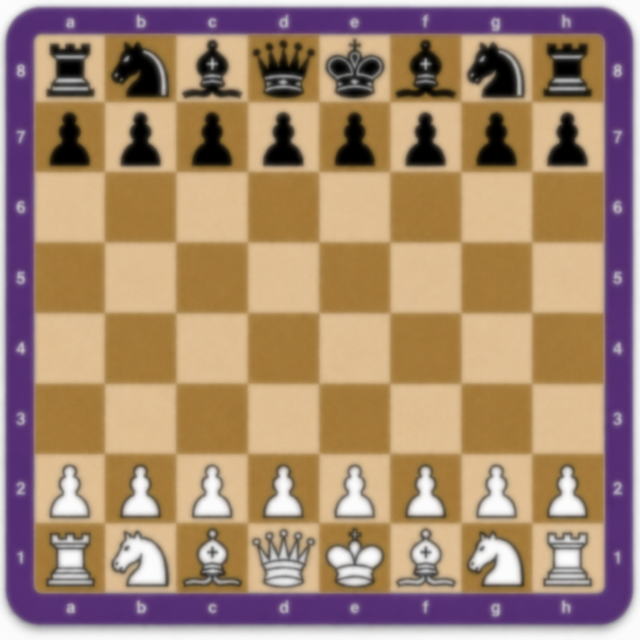
Now we have a mental image at the center of our conscious experience, which anchors our overall intuition about the sphere of potential experiences that could manifest if we were to start playing the game with a partner. We have an intuitive sense of how many mental ‘ticking’ states could be endured to finish the game, how the pieces can move, the rhythmic flow of board states that could unfold as each player makes their moves, and the possible end states of win, lose, or draw. There are innumerable positions, lines, and variations that exist within this dim, holistic intuition. Also compounded in our intuition is the feeling that all of the above is related to our performance of an occult exercise. The latter is now also part of our strategic flow context, helping to make sense of our current state of focus. Let's also note that our intuitive state can only feel as rich and refined as our compounded experience of actively playing and watching games. If we have never experimented with Chess, it will feel as if only a nebulous mist flows into the top of our head, with no distinguishing features; the mist could just as well be traced to a grid drawing of static and enigmatic white and black objects, as it could be to a game of Chess.
Then we can begin to collapse this holistic intuition of the game's ‘wavefunction’ in our imagination (as we also could with a physical or digital board). We act as our own partner and make a few reasonable moves for white and black until a relatively normal-looking position takes shape. If we imagine the holistic state as the title of a familiar song, it is as if we are now singing it and experiencing its rhythmic progression across bars, measures, and groups (analogous to operational, tactical, and strategic flows). Some of the superimposed potential we previously felt dimly from our ‘zoomed out’ perspective is now taking concrete form in our ‘zoomed in’ perspective, and we experience lucid mental images stacking against it. This feels like our open, concave headspace (when viewed from above) has now turned convex and enclosed itself with skin and bones, so it can focus (as if through a prism) and contain the previously expanded meaning with neatly delineated mental images.
Full essay - https://open.substack.com/pub/spiritana ... Share=true