Page 1 of 2

The Game Loop: Part 6 Concentration

Posted: Wed Jan 28, 2026 6:16 pm
by Cleric
The Game Loop
Part 6
Concentration


Google Doc version (easier to follow footnotes)

Part 1 Mental Pipelines
Part 2 Interleaved IO Flows I
Part 3 Interleaved IO Flows II
Part 4 In Search of the Fundamental Inputs I
Part 5 In Search of the Fundamental Inputs II
Part 6 Concentration


In our attempt to gain a more intimate experience of the way we interface with the game loop, we were gradually led to our inner life of thinking and imagination. Even though we are far from having unconditional control over these IO flows, they nevertheless present us with a much more in-phase experience of the way intuitive inputs and mental outputs correlate. Compared to that, our feeling and willing offer a more complicated resistance, as if there are more hidden factors that interfere with our inputs. It is as if there’s greater leeway; there are more ways our inputs can end up being out of phase with the outputs. Yet, at the same time, when we reach our mental IO flow, it seems we hit a limit. Even though we try to grasp what kinds of ‘buttons’ and ‘sticks’ we operate in order to produce a thought, we simply end up producing more mental images in the same nebulous way. We find ourselves at the event horizon where we instinctively, yet with some intuitive directedness, push toward a future state. When we say that we push toward the future, this doesn’t imply some movement through a temporal dimension of reality but only the bare facts of experience – namely, that our ever-present state continuously transforms. In the phenomenological outputs of this ever-present flow, we continuously become aware of the consequences of our intuitive pushing. We recognize how the compounding mental images (which are immediately already of the nature of memory images) have something to do with our dim inputs.

The reader may still have their doubts about whether what we speak of corresponds to reality. Such doubts can only arise as long as one is reluctant to feel themselves actively willful in their inner inputs. And in our particular age, this is somewhat understandable. We have already seen in the first part how both scientifically minded people and those mystically inclined have a kind of aversion, even fear, of this experience. At the intellectual surface, these feelings are rationalized as a kind of prudence based on sound understanding. One says, “I just don’t want to fall into an illusion, I don’t want to be like all those superstitious people who believe that there’s something real in their sense of agency.” Yet, whether we like it or not, this sense of agency is a given fact of our inner experience. Even when one denies it, like in the above sentence, one still utilizes it. Paradoxically, it is as if one secretly declares: “All forms of intuitively willed inputs are illusions except when I use these inputs for declaring them to be illusions.” Of course, one will hardly admit this because it immediately reveals an inner inconsistency. If one needs to be consistent, they would have to declare the denying thought to be just as illusory and doubtful as the affirming one1. We are not here to tell whether the sense of agency is real or not, but only to elucidate that it is possible to utilize that agency in such a way that more and more phenomenal outputs are grasped as receding impressions of intuitively guided will.

The above-mentioned limit is only there as long as we insist on finding the IO interface as a part of the output. With the risk of being repetitive, we need to direct attention to this tendency once again, since it is extraordinarily stubborn. Even if we conscientiously aim to overcome it, it easily happens that, even without noticing, we snap back to it like a broken record. It is rooted in a deeply ingrained sense that, in our intellectual sphere, we can inflate indefinitely to encompass all aspects of reality as mental images. We secretly seek some hypothetical God-like perspective that can place itself above all reality and contemplate its imagined potato pipeline as spread out at our feet. This keeps us seeking a symbolic replica of the true event horizon as a nicely shaped output-to-output process experienced through stacking mental images. The trouble is not that we make a symbolic mental image of the horizon. Even in our phenomenological approach we are doing that, but we only use it as a pointer to the actual experience. The problem is when we silently declare that the picture-in-picture potato modeling is the one and only way of knowing the essence of reality.

We need to realize that this inability to locate the true horizon in the output field is not some arbitrary handicap of human cognition that we should compensate for through more mental modeling, but an intrinsic aspect of reality. If we ignore that aspect, we are striking out a fundamental given in the mystery of existence. We act like trying to solve a maths problem where we arbitrarily dismiss some of the given conditions, and then wonder why we can’t find a non-ambiguous solution. We simply need to investigate things as they are, instead of trying to fit them into our preconceived expectations. We need to get comfortable with the fact that we can never behold the horizon of becoming in the way our intellect desires – as a mental or perceptual object that can be contained within our phenomenal volume. Instead, the horizon can only be intuitively known through the experience of continuous becoming – the precipitation of phenomenal states that reflect something of our intuitive pushing.

So, is it possible to deepen this experience and make it practically useful, instead of simply noting it as some peculiar end-limit of our cognitive abilities? To answer this, let’s remember how, when we think about our mental process, we switch from one kind of thinking to another. For example, when we are fully engaged in solving the chess puzzle from the previous part, we are busy stacking mental images according to our intuition of what next moves are compatible with the present state. However, to arrive at the reflection in the former sentence, we need to stop solving the puzzle and switch to a different kind of mental flow, one in which we are stacking memory images of our past psychological states of solving the puzzle. These two mental flows are largely incompatible; they are conversations on two different coffeehouse tables – we can switch from flowing through one or another, but cannot grasp them together simultaneously. What about when we think about the psychological reflection itself? Now we once again switch to a new kind of mental flow, which, however, is more similar to the one being examined in memory. They both stack memory images of psychological states, except that they are recursively related. We can even enter a flow where we reflect on the reflecting about the reflecting about the puzzle flow, and so on. This, however, besides being a peculiar mental exercise, doesn’t lead too far either. Our ordinary thinking and imagination can be compared to a walk through a gallery where we’re completely absorbed in the paintings we see (constituting the picture-in-picture flow), while our intuition about the walking itself, the fact that we are in a gallery, and so on, remains in the background. On the other hand, when we think about our psychological states, it is as if we walk through a gallery where the paintings aim to depict that very fact.

Image


This is still a step forward, because now our mental picture-in-picture flow (the succession of paintings) aims to represent something of the wider context of the primary flow. They become more self-similar; they are like video feedback where we experience the stacking reverberations of our momentary first-person phenomenal states. Nevertheless, as long as we strive to find the reality of our total real-time flow of becoming within the picture-in-picture mental flow, we still feel like the dog chasing its tail or like the hands trying to capture their real-time activity in the picture – the output of our mental images is always one step behind our real-time intuitive input.

But what if we change our strategy? Can we assume an inner stance that is more akin to the clay artist? Instead of trying to deaden our real-time flow by seeking its reality only through contemplation of its already past output snapshots, can we innerly position ourselves within that real-time flow and simply experience the precipitating mental images as dynamic, close to real-time, feedback to our intuitive artistic pushing? We can indeed do that, and we can begin with very simple experiments.

We can take a pencil and try to very slowly draw a curve while we are completely focused on the tip of the pencil. There shouldn’t be any jerks of attention, no skipping, no inner chatter. For at least a second, we should try to move the tip in a completely smooth, slow, and continuous manner, tightly following it with our gaze. It is very easy to see how we can become distracted. Our hand may continue to draw on ‘autopilot’ while our mental flow is carried over in some completely different direction, or our eyes continuously snap to other perceptions in our visual field. To make this exercise even more focused, we can take it entirely in our imagination. In this way, we reduce as far as possible the inherent leeway between intuitive inputs and bodily output perceptions. Now we can move the pencil tip, or simply the focal point of our attention, in our mind’s eye, while still trying to do so slowly and smoothly, avoiding any interruptions, any skipping of attention. As we try to do that, we aim to contemplate as closely as possible how the mental output2 is almost in perfect phase with the inputs of our intuitive intents. The key here is that we should no longer separate the two sides of our experience. We should not leave the movement on autopilot while we go on to philosophize about it in our inner voice. Neither should we surrender to completely passive contemplation and expect that the point of attention should move by itself, in the way outputs in our sensory-visual field do.

A similar exercise can be performed by producing a continuous vowel sound with our inner voice and slowly and smoothly morphing it through different vowels (a, e, i, o, u). This exercise is especially valuable because it helps us close the leeway even further. When we move the focal point of our attention, we still have the implicit feeling that we are ‘here’ and we focus on a point within phenomenal space ‘over there’. When we focus on the sound of our inner voice, the experience is even more intimate. We may actually discover that while we were focusing on the movement of attention, our inner voice was still mumbling something in the background. When we consciously engage in the shaping of inner sound, such background mumbling becomes practically impossible because we find ourselves unable to split our inner voice into two – one which produces a continuous vowel sound and another which comments in words.

Such experiments with our inner voice can be of the greatest value. We may find a strange tendency that fiercely resists such an exercise. There could be a strange, uneasy feeling when we experience our inner voice so consciously, much like we may feel when we hear our physical voice on a recording. We would much rather let the exercise free-fall instinctively, while we only oversee and comment from the background. If we are not clearly aware of this tendency, even if we try such exercises, it may happen that we secretly perform them as if we observe someone else doing them, or we vaguely imagine what it could be if we were to do them. This gives us a feeling of security that our inner sense of self, secretly hidden in the background, is safe and immutable. It is implicitly assumed that any such exercises only concern the reconfiguration of some output phenomena at a distance, while the goal is precisely to experience more closely the process that produces the reconfiguration and comments from the background. This reluctance to approach the process of shaping our inner mental gestures needs to be overcome if we are to gain a deeper experience at the IO interface. The two are simply mutually exclusive. We cannot attain deeper intuition for the way inputs are impressed in the outputs if we are unwilling to actively explore the only place where this can be found as an actual experience. If we refuse to approach this experience, we may try to build some theoretical picture about it, we may picture someone else going through it, but that mental picture will always feel remote and unrelated to the true inner inputs hidden in the background, which speak the theoretical thoughts or imagine what the experience of the exercise could be like. As long as our cognitive process remains instinctively proceeding from the background, we have the false security that we can pre-calculate everything in our mind before entering into contact with the wider flow. However, here it is precisely the goal to become lucidly aware at the threshold where even our pre-calculating thoughts (i.e., the background mumbling) can no longer be pre-calculated (we can’t think before we think). We need to get the clear feeling that we’re at the threshold between the known (past) and the unknown (future), and be willing to observe how even our inner voice precipitates as something that we could not have perceived as imaginative output before we have intuitively pushed into the unknown next state.

Granted that the reader has the goodwill to follow along this path of inner experience (otherwise, what follows simply won’t make much sense), we nevertheless stumble upon the next obstacle. It is enough to attempt these focused exercises even for a second to realize that it often feels like trying to draw a smooth line with our hand amid a battlefield. We are constantly assailed from all directions by influences that very easily throw us off track. We can illustrate this process in the following way:

Image


Here, we start with our focused mental activity (the vertical line starting from below), but then, at the moment of distraction, we are thrown into another IO track. The nature of this moment is very elusive since, in general, we do not have clear awareness that we are being distracted. This is deeply related to the way we fall asleep each night. Normally, we do not have consciousness of “I’m awake, and now I transition into sleep.” Instead, it is as if we lose consciousness, and when we eventually become aware within a flow of dream imagery, our dream state lacks the well-compounded intuitive context that makes us implicitly aware of our progression through waking life3. Things change when we transition to a state that reunites the two flows. In the morning, we find ourselves in a state that coheres the intuitive compounding of both the dream stream and that of the previous waking life up to the moment of falling asleep. Something completely analogous, yet on a much smaller scale, happens in our moment-to-moment mental flow. As soon as we become distracted, it is as if we fall asleep; we lapse into a daydream flow where the intuition of “I’m concentrating my mental activity” is no longer present. Instead, we continue daydreaming through the new stream, and only when the two IO flows ‘cross paths’ again, we experience their superimposed intuition, and we say, “Oh, I was trying to concentrate on the exercise, but at some point I got distracted and switched flows.”

What does it mean that we got distracted? It means that some unknown factor beyond the power of our focused input has nudged our flow into a differently shaped riverbed. Here, the physicist or biologist would immediately object, “But such unknown factors are only mirages in consciousness. In reality, there’s nothing ‘nudging’ our ‘flow’. It is all an emergent picture of fundamental physical processes.” The fact, however, is that even if we call these nudges mirages, this in no way makes it possible to ‘walk through them’. From a phenomenological perspective, when we speak of such nudging forces, we are not in the least postulating any metaphysical processes that ‘explain’ them. As long as we’re focused on the bare facts, we can’t go wrong. It is to these bare facts that we point when we speak of nudging forces, not to some speculative glowing energies. In other words, we are concerned not with mental stacks that try to explain what causes these forces, what stands behind them, and so on, but only with the most immediate fact that our intuitive input is being modified and thus the actual output differs from the intuitively anticipated one.

Through some effort and persistence, it is possible to resist such nudges. Just like we need some strength training if we are to stay on our feet when nudged by a crowd, so we need a certain strength of mental input if we are to maintain the intended curvature of our inner flow. What is interesting is how the inner nudges are now experienced. They certainly feel like some unknown factors that compel us to think about this or that, but when we try to resist them, these nudges are experienced from within our first-person flow, similar to an imaginative flash accompanied by intuitive insight. In a sense, we become conscious of in what direction our inner flow might have gone if the switching had not been arrested in time. Interestingly, even though the flow didn’t switch completely in that direction, from within this flash of insight, we intuitively know quite a lot about how it would have turned out were we to follow it. It is like these nudges push us off-course only enough to be conscious of the intuitive curvature specific to their flow, but not so far that we fall asleep, and only later awaken and reunite the streams.

Image


We should try to get a feeling for the effort needed here. It is one of intense vigilance. The mental image that we have chosen for anchoring our attention (we can even use the focal point of attention itself) is of secondary importance. It can be compared to a ridge that the clay artist shapes by holding their finger steady while the pot turns on the wheel. Even though the shape of the ridge seems static, it is the result of continuous steady activity. If someone pushes the artist’s hand, a bump in the ridge would be formed. The same idea can be conveyed through the image of the seismograph.

Image


Here, the needle tip symbolizes our focused sustaining of the mental image. A concentrated activity would result in a straight line, while all perturbations in the gravity field result in wiggles. The ridge and the graph line must be understood in the sense of the stacking chess-puzzle frames, and not as a spatial line, nor as some temporal dimension. Both metaphors suggest that the resulting impressions only testify to the effects of the forces. In other words, we do not see the reality of the nudging forces in the mental outputs. This is very important to understand, because otherwise we can easily fall into a certain naivety if we believe that the imaginative flashes constitute the objective reality of the nudging forces. This would be like believing that the perturbing forces affecting the seismograph are contained and act from within the line ink.

Seen in this way, the output mental image at our focus is only the near-real-time feedback of how well we are stabilizing our intuitive input activity, how free of interruptions it is, and how well we resist the perturbations to our ‘steady mental needle’. When we strive to intercept the potential nudges and thus avoid the interruptions, it feels as if we try to ‘split the moment’. We concentrate ever so finely, such that we do not ‘miss a beat’. If we blink, we may miss the moment, and we are off into the dream ridge, only later to reunite again with our intentions.

Image
Splitting the moment


It should go without saying that when using an expression like ‘splitting the moment’, we should by no means imagine some fantastic output blob that we call a ‘moment’ and then try to split it in the way we split a cotton ball into smaller balls. No, the ‘splitting’ is an artistic expression for the way we try to shorten the leeway between our intuitive inputs and the outputs in our imagination, for example, when we move the imagined pencil tip. We strive to decrease as far as possible any slack between intent (input) and image (output) because it is in between the two that we fall asleep and switch tracks. Another metaphor that we can use to illustrate this idea is that of stroboscopy. Here, we have short flashes of light that illuminate the environment, followed by periods of darkness.

Image


It is as if in these dark periods of sleep, the switching of flows occurs. Thus, ‘splitting the moment’ is like focusing our attention so tightly as if we want to increase the strobing rate, such that we do not miss anything. This metaphor also provides another valuable intuition. We can see that if the strobing happens at the appropriate times, the perceived dynamics may be different from the actual. This is exemplified by the wagon wheel effect.


Here, the strobing is produced by the camera’s shutter, but the effect would be the same if we were looking at the disc in a dark room and there was a strobe light flashing at the same rate as the camera’s frame rate. This metaphor will become more relevant later in the series. At this time, it is enough to consider how there’s a lot that we may be missing in our inner flow, and that the intuitive story that we compound by stacking the illuminated frames may not fully coincide with what we would experience if more frames were alit.

Such activity of intensified attention (increased strobing rate) and experiencing the nudges as we resist them, seems complicated and speculative only as long as we are busy philosophizing about it. As soon as we put the philosophizing aside and actually try it, everything becomes clear on its own. We quickly understand what all these words are pictures of. Even if we utterly fail to resist the nudges, the attempt in itself already gives us a rich first-person intuition about this process. Least of all, we would no longer be able to deny that we’re dealing with real experiential factors of our existential flow. What is real is not our fantasies about what might stand ‘behind’ these forces, nor is the imaginative content of the flash their ‘objective’ reality, but the experience of the nudging compulsion in itself – the fact that we’re forced to flow through this or that riverbed of experience. All our concepts and images are only attempts to symbolically convey these real experiences.

We’ll continue to explore this direction in the next part of the series. Here we only need to become familiar with the idea that by striving to sustain a certain ‘shape’ of our inner flow, we begin to gain consciousness of factors that normally shape our stream of becoming with very little awareness on our side. As a simple example, let’s say that while we try to concentrate, something continuously tries to push us into a riverbed where we daydream through scenes of our favorite TV show. By resisting this push, we achieve two things simultaneously. First, we became conscious that such a tendency indeed exists. We may have never before been fully awake to the fact that we spend quite a lot of time free-falling through such daydreams. Second, by resisting the nudge, we become conscious that we are, in fact, able to do so. In a way, we become aware of what ‘muscles’ we are activating in order to counteract the nudge. As an analogy, if we stand in a crowd pushing us from different directions, by trying to stay straight, we may become aware of how we instinctively activate different muscles depending on whether the push is coming from the front, the side, etc. Similarly, we try to concentrate and stabilize our flow more or less instinctively, yet as we resist the distracting forces, we also become conscious of unsuspected ‘input muscles’, which, when mastered, allow us to navigate the landscape of interfering nudging forces in new ways.

Keynotes:

💡Sustaining a given mental image or even only focusing our attention on a point leads to a flow-state of concentration.

💡Even though this activity seems to support a static space-like image, we should feel that it is the result of continuous effort through time, like the ridge that the clay artist impresses or the line that the seismograph draws.

💡 This concentration is constantly threatened by the most varied distractions. They feel like repulsions and attractions that can easily throw us into a different IO flow.

💡 By concentrating with the intent to arrest any such nudge before it takes us over in a different flow, it feels as if we increase the ‘strobing rate’ of our conscious experience. We strive to slow down and ‘split the moment’, as if not to ‘miss a beat’.

💡 The nudges that we resist still impress in our consciousness as imaginative flashes. They slightly bend our trajectory, yet without throwing us off course (there’s no interruption in our continuous intent to maintain the trajectory). This gives us intuition about the most varied flow-tendencies within our inner life, which we have so far been falling through without any awareness, but now become investigatable and even navigatable.


-----
1 This, however, immediately leads to a paradox again (known as the liar’s paradox). If our thinking is inherently illusory and unreliable (thus both denying and affirming thoughts are doubtful) then even the statement about its unreliability can no longer be trusted! This keeps the intellect cycling through the contradictory statements.
2 This mental output doesn’t need to be anything vivid – it’s more than enough that we have some sensation of where our ray of attention is pointed. Anyone can sense whether their focus is more to the left side of their forehead or the right. It is this pointing of attention that we need to sharpen, turning into a laser beam, so to speak, and tightly experience its movement.
3 Reflecting deeper on such facts can help us appreciate how the compounded intuitive sense for the story of our life is found at the ‘tip’ of our flow of becoming – that is, our ever-present state. For example, we may say, “But I positively remember that I was doing so and so yesterday. I was ‘there’.” Yet, we can do a thought experiment and imagine that the game state has been somehow ‘manually’ assembled into our present state and the game loop was ‘started’. Effectively, it is impossible to tell whether we have really lived through the past states or it only seems so from within the intuitive context of our present state. Such lines of thought have been explored in science fiction, such as the movie Total Recall (based on a novel). If we could be implanted with sensory and emotional memories of having been on an exotic vacation (and not remembering the implantation), would we feel the same satisfaction that we were ‘there’ as if we really had been? In our dream states we have something comparable, where we become aware within a partial intuitive context. Often we dream of being in different places, at different times, without really questioning them, since we have no awareness of going to sleep. We do not remember that we have other life in the waking state. Each of these dream states feels like the tip of the flow of becoming, that compounds the intuition of its unique story. An interesting case is that of lucid dreaming, where we reunite with some of our waking intuition while still in the dream state.

Re: The Game Loop: Part 6 Concentration

Posted: Thu Jan 29, 2026 3:14 pm
by Federica
Fantastic treatment, Cleric, helpful in many ways... thank you!
Much to work with and reflect on. I will keep doing it. For now, just a brief thought.
Cleric wrote: Wed Jan 28, 2026 6:16 pm The above-mentioned limit is only there as long as we insist on finding the IO interface as a part of the output. With the risk of being repetitive, we need to direct attention to this tendency once again, since it is extraordinarily stubborn. Even if we conscientiously aim to overcome it, it easily happens that, even without noticing, we snap back to it like a broken record. It is rooted in a deeply ingrained sense that, in our intellectual sphere, we can inflate indefinitely to encompass all aspects of reality as mental images. We secretly seek some hypothetical God-like perspective that can place itself above all reality and contemplate its imagined potato pipeline as spread out at our feet.

This is so well expressed. At a conscious level, this secret aspiration would translate to: “If I can’t think about something I want to understand, what else can be done?? I must be able to grasp reality by thinking about it, abstractly and/or by encompassing the facts of outer experience in thought”. It seems utterly absurd, at first, that any other way may exist. It looks as if any other way that wouldn’t consist of analysis and reflection must be nothing other than inconclusive passivity. Necessarily, the idea must take shape that the next upgrade in human cognitive power requires a radical change of arena, not an augmentation of well trodden current cognitive modalities. It must dawn to the future-looking mind that the traditional authority figure, the scientist and the philosopher whose merit and dignity is measured by their ability to juggle with concepts and gather consensus by dragging other minds along their patterns of juggling, are about to become complete has-been, and mere followers, if they insist on confining themselves to only boot up the mental juggling procedure, with no expansion of cognitive mode.

Perhaps this could be also framed in terms of strategic foresight, experience design, futurism, I am wondering. These are some fields of strategic thinking used by certain organizations for large-spectrum “sense making”, to help orient their high-level strategy and vision. Perhaps they could hear that "innovation" can't be limited any longer to external technology, and not even to the kind of embodied technology people like Michael Levin are developing, but should be extended to the cognitive modalities used to apprehend and direct the evolving technologies in the first place, if we want to have a chance to contain and repossess the phase-gap everyone is growing scared of today. This is not the IO phase-gap you speak of, but sort of its outer reflection: the more we become clever and refine our technological grip on outer reality and its matching concepts, the more that same reality seems to escape our grasp and spiral up towards unforeseen, disruptive effects. We are seeing this across the board today, from AI to geopolitics. The fear generated by these trends is specular to the fear of introspective experience pointed to above. The more we fear the next cognitive upgrade standing before us, giving in to ingrained habits and drives instead, the more we will lose grip on our individual and collective life, and we are indeed right to be in fear of the consequences...

Re: The Game Loop: Part 6 Concentration

Posted: Thu Jan 29, 2026 6:51 pm
by AshvinP
Cleric wrote: Wed Jan 28, 2026 6:16 pm Such activity of intensified attention (increased strobing rate) and experiencing the nudges as we resist them, seems complicated and speculative only as long as we are busy philosophizing about it. As soon as we put the philosophizing aside and actually try it, everything becomes clear on its own. We quickly understand what all these words are pictures of.
Thank you, Cleric!

As I was reading this part, it occurred to me that a central obstacle in this domain could be characterized as a 'lack of seriousness' within the cognitive flow, which, for the modern soul, is the flow of life in general. As modern thinking souls, we simply lack seriousness about the implications of all of our instinctively pursued ideas and actions (similarly, we could say there is a lack of seriousness because they are instinctively instead of consciously shaped and pursued). The endless philosophical debates only seem reasonable as long as we remain unaware or otherwise refuse to 'try on' the ideas we are exploring through concentrated exercises. For example, the debate you mentioned over whether there is such a thing as 'free will'. We simply can't take our experience of inner agency seriously enough to stop debating for a while and "utilize that agency in such a way that more and more phenomenal outputs are grasped as receding impressions of intuitively guided will." Or rather, we instinctively utilize our agency in such a way within limited domains, but can't take what we are doing seriously enough to recognize that fact and pursue its implications into broader spheres of meaning.

It's interesting to consider that, whenever we try to get proficient at something, we are instinctively pursuing higher cognition. To invoke the chess example again, a high level of play is only possible when we work on making our inner gestures very patient, disciplined, and concentrated within the moment-to-moment states of play. Cultivating those inner qualities allows us to more keenly sense the compounded intuitive reverberations of our stacking mental pictures and therefore find optimal moves in the various board states we encounter. Such games are helpful as examples because the rules of transformation are simple, and therefore we can more easily hone in on the inner process at play, but the same principles apply to any life skills that we are trying to develop within the wider IO flows. The main reason such pursuits do not lead to higher cognition is that the goal state, or series of goal states, is arbitrarily limited by our past natural-cultural conditioning. The inner process is cultivated to only reach such myopic goal states that are prescribed for us, rather than being pursued for its own sake in an open-ended way.

Such a lack of seriousness within the inner flow should not be confused with some rational decision that we can just as easily choose to change. The phenomenological observation of psychological states certainly makes us a bit more serious, but the seriousness is only truly attained and maintained through consistent and conscious concentration within the inner process, which is pursued for its own sake, out of love for that inner process and its eternal and infinite possibilities. Animal behavior gives us a great image of the deeper level of seriousness we need to attain. Whenever they do something, they do it with utmost seriousness. For example, if my cat makes a funny gesture and I respond by smiling or laughing, she will just stare at me in a completely serious manner. For at least a few moments, she is absorbed in this phenomenal flow of impressions with unmitigated interest and wonder. Of course, this level of seriousness is completely instinctive for the animal, and it is something humanity needs to rediscover with full consciousness. It's like we need to voluntarily resist the tendency to 'laugh everything off'. In intellectual life, laughing something off is when we don't pursue the implications of our ideas to their natural conclusion, a "conclusion" which is a never-ending expansion of intuitive orientation through concentrated thinking experience for its own sake.

Re: The Game Loop: Part 6 Concentration

Posted: Thu Jan 29, 2026 11:01 pm
by Kaje977
Cleric wrote: Wed Jan 28, 2026 6:16 pm -- Essay --
Thank you very much once again for this very insightful post, Cleric!
AshvinP wrote: Thu Jan 29, 2026 6:51 pm Such a lack of seriousness within the inner flow should not be confused with some rational decision that we can just as easily choose to change. The phenomenological observation of psychological states certainly makes us a bit more serious, but the seriousness is only truly attained and maintained through consistent and conscious concentration within the inner process, which is pursued for its own sake, out of love for that inner process and its eternal and infinite possibilities. Animal behavior gives us a great image of the deeper level of seriousness we need to attain. Whenever they do something, they do it with utmost seriousness. For example, if my cat makes a funny gesture and I respond by smiling or laughing, she will just stare at me in a completely serious manner. For at least a few moments, she is absorbed in this phenomenal flow of impressions with unmitigated interest and wonder. Of course, this level of seriousness is completely instinctive for the animal, and it is something humanity needs to rediscover with full consciousness. It's like we need to voluntarily resist the tendency to 'laugh everything off'. In intellectual life, laughing something off is when we don't pursue the implications of our ideas to their natural conclusion, a "conclusion" which is a never-ending expansion of intuitive orientation through concentrated thinking experience for its own sake.
Ashvin, I think the implications here you are making are very crucial and important when looking at today's landscape. Although humanity has been dealing with problems in this way for a long time, we have noticed this typical "laugh it off" approach in modern meme culture in particular. Since around 2013/2014, the meme culture of the internet has shifted away from a simple form of humor, a joke, and more towards a form of avoiding serious and grave problems. This form of "distraction" is taking on ever crazier proportions, for example when we look at modern ‘memes’ known as “brainrot” (e.g. "tung tung sahur", ": Loud noises in the background, random videos snipped together. Example:


Interestingly enough, this phenomenon also occurred in the 20th century. Namely, when Dadaism and similar art forms flourished, especially in those times shortly before the end of the First World War and the post-war period of the First World War. A similar pattern dominated here too: no inhibitions, no rules, rejection of systems and everything is parodied and "turned into a joke", we see a lot of great works of arts that used "mash-up" techniques where nothing makes sense, where everything becomes a puddle and we no longer recognize clear harmonic patterns. The problems are ignored, the delusional obsession with war enthusiasm is ignored, etc. All because the dark and terrible truth was that society did not want to deal with the facts of the war and the next one that was already looming. It would be foolish to believe that no one in the "Golden 1920s" (as it was called so often in Germany) knew what was coming very soon. History repeats itself because we keep making the same mistakes. It is therefore only a matter of time before the consequences of ignoring, ducking away and "laughing it off" will once again bite us in the ass.

Re: The Game Loop: Part 6 Concentration

Posted: Fri Jan 30, 2026 3:51 pm
by AshvinP
Kaje977 wrote: Thu Jan 29, 2026 11:01 pm Interestingly enough, this phenomenon also occurred in the 20th century. Namely, when Dadaism and similar art forms flourished, especially in those times shortly before the end of the First World War and the post-war period of the First World War. A similar pattern dominated here too: no inhibitions, no rules, rejection of systems and everything is parodied and "turned into a joke", we see a lot of great works of arts that used "mash-up" techniques where nothing makes sense, where everything becomes a puddle and we no longer recognize clear harmonic patterns. The problems are ignored, the delusional obsession with war enthusiasm is ignored, etc. All because the dark and terrible truth was that society did not want to deal with the facts of the war and the next one that was already looming. It would be foolish to believe that no one in the "Golden 1920s" (as it was called so often in Germany) knew what was coming very soon. History repeats itself because we keep making the same mistakes. It is therefore only a matter of time before the consequences of ignoring, ducking away and "laughing it off" will once again bite us in the ass.

Thanks for bringing our attention to this connection, Kaje. The example you shared is painful to listen to, but it can help us get a sense of the inner cacophony towards which segments of humanity are descending if they fail to take the experience of the I/O flows more seriously. I think you are correct that this trend has picked up lately, and now many people take pride in creating 'parodies of parodies' as some imagined art form. It is a direct symptom of the endless mental recursion that Cleric and Federica also highlighted. It is like the futility of this mental recursive process reaching the spiritual foundations is sensed, and therefore, it is felt that the best bet is to proceed with cynicism and make a mockery of the I/O flows. Futility transforms into absurdity. As we know, there is a deep connection between 'laughing off' and anxiety/fear with respect to the event horizon of the I/O threshold. We often resort to laughter when we are nervous or afraid.

Similar to your example, I like to meditate on animal behavior to more keenly sense the difference between the seriousness of my current inner process and that which it could be through the proper inner exercises. These things can hold up a mirror to us and reveal just how distorted and caricatured our image has become in comparison to the Divine image-ideal. Many of us imagine we take the flow of life seriously, but through concentration and intuitive flashes of the constraining forces that nudge our inner life into various 'spikes on the graph', we can begin to sense just how often we are laughing the experience of that flow off and substituting it with inner chatter, with mental doll-making and doll-dressing. Out of a deep fear and anxiety of experiencing the event horizon, we go to great lengths to parody the primary I/O flow with our picture-in-picture mental flow.

For the animal, every state of the flow is experienced with the highest stakes. We still have a dim feeling for this when navigating our dream life, although that experience is already somewhat intellectualized and thus caricatured, especially since we can only reflect on the dream flow after awakening into the intellectual state. We can try to introduce such high stakes into our meditation, as if we are diffusing a bomb that would kill millions or performing a critical surgery on a loved one. Placing our meditation within such a context can help clothe our meditation in a more serious mood, at least for a few moments. Such imaginations aren't even untruthful, in a deeper sense, because our imaginative I/O flow does indeed carry the highest stakes, as your examples also show. It's only that we cannot normally intuitively trace those stakes because the relations between the inputs and outputs have grown so complicated and temporally diffused.

As the Buddha observed, "What/How you think, you will become." If we think like machines, we will become machines. If we think cynically and by parodying the flow, we will become a cynical parody of our true self. By clothing our meditation in a serious high-stakes mood, on the other hand, we are making our imaginative I/O flow more self-similar to the deeper feeling-willing flows of our true self, and bringing their concentric relationships more in-phase. Then the temporarily extended outputs of our imaginative I/O flow will no longer be experienced as coming from nowhere and biting us in the ass, but as the lawful and redemptive consequences of our inner flow that help us continually course-correct toward the Divine ideal.

Re: The Game Loop: Part 6 Concentration

Posted: Sat Jan 31, 2026 12:47 pm
by AshvinP
Cleric wrote: Wed Jan 28, 2026 6:16 pm We can take a pencil and try to very slowly draw a curve while we are completely focused on the tip of the pencil. There shouldn’t be any jerks of attention, no skipping, no inner chatter. For at least a second, we should try to move the tip in a completely smooth, slow, and continuous manner, tightly following it with our gaze. It is very easy to see how we can become distracted. Our hand may continue to draw on ‘autopilot’ while our mental flow is carried over in some completely different direction, or our eyes continuously snap to other perceptions in our visual field. To make this exercise even more focused, we can take it entirely in our imagination. In this way, we reduce as far as possible the inherent leeway between intuitive inputs and bodily output perceptions. Now we can move the pencil tip, or simply the focal point of our attention, in our mind’s eye, while still trying to do so slowly and smoothly, avoiding any interruptions, any skipping of attention. As we try to do that, we aim to contemplate as closely as possible how the mental output2 is almost in perfect phase with the inputs of our intuitive intents. The key here is that we should no longer separate the two sides of our experience. We should not leave the movement on autopilot while we go on to philosophize about it in our inner voice. Neither should we surrender to completely passive contemplation and expect that the point of attention should move by itself, in the way outputs in our sensory-visual field do.

A similar exercise can be performed by producing a continuous vowel sound with our inner voice and slowly and smoothly morphing it through different vowels (a, e, i, o, u). This exercise is especially valuable because it helps us close the leeway even further. When we move the focal point of our attention, we still have the implicit feeling that we are ‘here’ and we focus on a point within phenomenal space ‘over there’. When we focus on the sound of our inner voice, the experience is even more intimate. We may actually discover that while we were focusing on the movement of attention, our inner voice was still mumbling something in the background. When we consciously engage in the shaping of inner sound, such background mumbling becomes practically impossible because we find ourselves unable to split our inner voice into two – one which produces a continuous vowel sound and another which comments in words.

I'd like to add a tip with respect to these concentration exercises. Performing the inner movements on autopilot has been something I have consistently struggled with. It is indeed very difficult to notice when we have switched tracks from intensely concentrated gestures and are simply carrying out the movement as a force of habit, for the reasons that Cleric discussed. (when this happens, we will usually notice, once we have awakened back into the concentrated gesture, that we have been rushing through the movements as if trying to get a chore done quickly). One strategy I've been working with is to temporally stagger the movements in an improvisational way. I imagine this will be very difficult for any exercise involving the physical hands, because of the additional leeway when our inputs are conducted through the physical architecture. There could be additional physical strain and aches associated with pausing our movement in that way, for example. Or if we have shaky hands, that will act as a source of distraction as well. Yet if we conduct it entirely in our imagination, then we can try to pause the smooth movement every now and then, while remaining intensely concentrated on the tip of our activity, before resuming movement. We should avoid making the pauses at regular intervals, i.e., like we are planning them out beforehand, but rather improvise them 'randomly'. I think this works even better for the vowel exercise when transitioning from one vowel sound to the next - we can avoid making the transitions at regular intervals. The staggered inner movements can help mitigate the tendency towards snapping into autopilot mode and simply relying on force of habit, while our mental flow begins to wander and chatter. We should feel an additional characteristic hesitancy and resistance when we stagger the concentrated inner gesture in this way, as if it is something unfamiliar and uncomfortable. That is how we know it is helping to lift us from well-known patterns of inner activity, into a more novel inner stance.

Re: The Game Loop: Part 6 Concentration

Posted: Sat Jan 31, 2026 7:18 pm
by Cleric
Thank you all for the feedback!
This part was supposed to address the further meditative aspect too, but it all became too long, and I split it into two parts. I hope that I'll be able to post it in the coming week.
AshvinP wrote: Sat Jan 31, 2026 12:47 pm I'd like to add a tip with respect to these concentration exercises. Performing the inner movements on autopilot has been something I have consistently struggled with. It is indeed very difficult to notice when we have switched tracks from intensely concentrated gestures and are simply carrying out the movement as a force of habit, for the reasons that Cleric discussed. (when this happens, we will usually notice, once we have awakened back into the concentrated gesture, that we have been rushing through the movements as if trying to get a chore done quickly). One strategy I've been working with is to temporally stagger the movements in an improvisational way. I imagine this will be very difficult for any exercise involving the physical hands, because of the additional leeway when our inputs are conducted through the physical architecture. There could be additional physical strain and aches associated with pausing our movement in that way, for example. Or if we have shaky hands, that will act as a source of distraction as well. Yet if we conduct it entirely in our imagination, then we can try to pause the smooth movement every now and then, while remaining intensely concentrated on the tip of our activity, before resuming movement. We should avoid making the pauses at regular intervals, i.e., like we are planning them out beforehand, but rather improvise them 'randomly'. I think this works even better for the vowel exercise when transitioning from one vowel sound to the next - we can avoid making the transitions at regular intervals. The staggered inner movements can help mitigate the tendency towards snapping into autopilot mode and simply relying on force of habit, while our mental flow begins to wander and chatter. We should feel an additional characteristic hesitancy and resistance when we stagger the concentrated inner gesture in this way, as if it is something unfamiliar and uncomfortable. That is how we know it is helping to lift us from well-known patterns of inner activity, into a more novel inner stance.
Thanks, Ashvin. As a whole, any kind of experimentation is better than no experimentation :) And of course, it is always up to the person to seek vigilance. For example, if we're not careful, we may easily focus too much on the pauses and simply fly over the in-betweens. So maybe one way to counteract this is if we imagine that these stops should become closer and closer, that is, we try to move in increments that become smaller and smaller. It is an interesting experiment in itself to see what is the smallest increment in which we can move our ray of attention.
Something else that can help us be more present in the inner activity (something which I regularly use when I need to overcome inner turbulence), is holding our breath for a moment. Holding the breath should not require effort of the diaphragm and chest. It should be held by the vocal fold (glottis) like a valve. When you strain (like lifting something very heavy), you instinctively close your glottis to create internal pressure, which stabilizes your spine from the inside out. This is how the breath should be held, with the chest, diaphragm, and abdomen completely relaxed (another possibility is to simply fully exhale and completely relax, without closing the glottis, but this gives us less time). In this state I find it easier to perform slow and smooth inner movements, without 'lifting the pen' of attention. When the turbulence is calmed, we can breathe normally (also slowly and smoothly) without it interfering with our inner process.

Re: The Game Loop: Part 6 Concentration

Posted: Sun Feb 01, 2026 1:41 pm
by AshvinP
Cleric wrote: Sat Jan 31, 2026 7:18 pm Thanks, Ashvin. As a whole, any kind of experimentation is better than no experimentation :) And of course, it is always up to the person to seek vigilance. For example, if we're not careful, we may easily focus too much on the pauses and simply fly over the in-betweens. So maybe one way to counteract this is if we imagine that these stops should become closer and closer, that is, we try to move in increments that become smaller and smaller. It is an interesting experiment in itself to see what is the smallest increment in which we can move our ray of attention.

Right, your modification here makes sense. Generally, nothing will prevent some form of autopilot from taking over except great inner vigilance. Also, overall, I find the vowel exercise to be much more supportive of an uninterrupted concentrated state than moving the ray of attention (which I nevertheless still engage in, mostly for the sake of variety). With the former, we don't need to pause and restart any movements or pronounciations, but we can simply stagger the transitions between our inner gestures focusing the vowel sounds from our intuitive context.

Another aspect is that I find it is easier to mitigate the mind container perspective with the vowel exercise. As you alluded to, when we focus on moving the ray of attention, it still feels like we are 'over here' focusing on a point that we encompass 'over there'. This point feels the same as any of the ordinary mental pictures that we manipulate in the process of thinking. With the vowels, it feels a bit easier to relax and allow the sound to diffuse into the inner atmosphere and become like an aura in which our concentrated state is encompassed and unfolds. (Perhaps that's related to the fact that we no longer feel the instinctive need to follow anything with our eyes, along with the fact that we can't continue mumbling with the inner voice in the background, as you mentioned.)

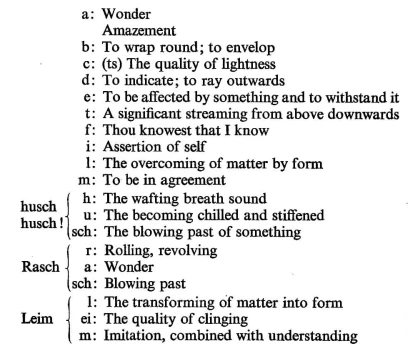
That is especially the case if we can feel the vowels tinged with certain archetypal moods, as Steiner discusses here, for example.

Image


Of course, these are archetypal feeling qualities that come to expression in the most varied circumstances of individual and collective life. When our inner gestures of focusing the vowels are tinged with these qualities, we can feel our concentrated state as if embedded within encompassing spheres of meaning that extend well beyond our local soul volume and its myopic interests. We are no longer focusing on an encompassed point 'over there' and trying to manipulate it, but we are within the 'over there', focusing its encompassing meaning into a continuously felt stream of vowel-pictures that directly coincide with the archetypal context being patiently and smoothly navigated.

Something else that can help us be more present in the inner activity (something which I regularly use when I need to overcome inner turbulence), is holding our breath for a moment. Holding the breath should not require effort of the diaphragm and chest. It should be held by the vocal fold (glottis) like a valve. When you strain (like lifting something very heavy), you instinctively close your glottis to create internal pressure, which stabilizes your spine from the inside out. This is how the breath should be held, with the chest, diaphragm, and abdomen completely relaxed (another possibility is to simply fully exhale and completely relax, without closing the glottis, but this gives us less time). In this state I find it easier to perform slow and smooth inner movements, without 'lifting the pen' of attention. When the turbulence is calmed, we can breathe normally (also slowly and smoothly) without it interfering with our inner process.
Thanks, this is surely a helpful tip to experiment with!

Re: The Game Loop: Part 6 Concentration

Posted: Fri Feb 06, 2026 1:05 pm
by Federica
AshvinP wrote: Thu Jan 29, 2026 6:51 pm It's interesting to consider that, whenever we try to get proficient at something, we are instinctively pursuing higher cognition. To invoke the chess example again, a high level of play is only possible when we work on making our inner gestures very patient, disciplined, and concentrated within the moment-to-moment states of play. Cultivating those inner qualities allows us to more keenly sense the compounded intuitive reverberations of our stacking mental pictures and therefore find optimal moves in the various board states we encounter. Such games are helpful as examples because the rules of transformation are simple, and therefore we can more easily hone in on the inner process at play, but the same principles apply to any life skills that we are trying to develop within the wider IO flows. The main reason such pursuits do not lead to higher cognition is that the goal state, or series of goal states, is arbitrarily limited by our past natural-cultural conditioning. The inner process is cultivated to only reach such myopic goal states that are prescribed for us, rather than being pursued for its own sake in an open-ended way.


I would comment here that, while games are extremely helpful examples (for the reasons given above, and because they are very relatable for many) they don’t have - by nature - “their own sake”. If the reason why pursuits of proficiency in the wider IO flows don’t lead to higher cognition is that the process is only executed myopically, to attain culturally prescribed end goals, and not for their own sake, then games can become dangerous, when used beyond their function of example, because they simply and intrinsically lack an "own sake".

The nature of game is educational. The mere entertainment value of game is an unserious value of game. Game allows the young and the neophyte to learn, under favorable, staged conditions, something that has to be later applied in the wider IO flows. Once, by their simplicity, games have instructed the mind to identify and trace the nature of the cognitive process that navigates them, they have exhausted their function. Any further insistence and persistence in the world of game beyond its educational value (and all that relates to it) is a deformation of the good curvature, in my opinion.

Re: The Game Loop: Part 6 Concentration

Posted: Fri Feb 06, 2026 5:12 pm
by AshvinP
Federica wrote: Fri Feb 06, 2026 1:05 pm
AshvinP wrote: Thu Jan 29, 2026 6:51 pm It's interesting to consider that, whenever we try to get proficient at something, we are instinctively pursuing higher cognition. To invoke the chess example again, a high level of play is only possible when we work on making our inner gestures very patient, disciplined, and concentrated within the moment-to-moment states of play. Cultivating those inner qualities allows us to more keenly sense the compounded intuitive reverberations of our stacking mental pictures and therefore find optimal moves in the various board states we encounter. Such games are helpful as examples because the rules of transformation are simple, and therefore we can more easily hone in on the inner process at play, but the same principles apply to any life skills that we are trying to develop within the wider IO flows. The main reason such pursuits do not lead to higher cognition is that the goal state, or series of goal states, is arbitrarily limited by our past natural-cultural conditioning. The inner process is cultivated to only reach such myopic goal states that are prescribed for us, rather than being pursued for its own sake in an open-ended way.


I would comment here that, while games are extremely helpful examples (for the reasons given above, and because they are very relatable for many) they don’t have - by nature - “their own sake”. If the reason why pursuits of proficiency in the wider IO flows don’t lead to higher cognition is that the process is only executed myopically, to attain culturally prescribed end goals, and not for their own sake, then games can become dangerous, when used beyond their function of example, because they simply and intrinsically lack an "own sake".

The nature of game is educational. The mere entertainment value of game is an unserious value of game. Game allows the young and the neophyte to learn, under favorable, staged conditions, something that has to be later applied in the wider IO flows. Once, by their simplicity, games have instructed the mind to identify and trace the nature of the cognitive process that navigates them, they have exhausted their function. Any further insistence and persistence in the world of game beyond its educational value (and all that relates to it) is a deformation of the good curvature, in my opinion.

Right, and in a certain sense, all human activities (not only games, but work, relationships, etc.) are only pursued for 'their own sake' when they become pedagogical tools for a higher existence. Until then, such activities remain constrained by myopic cultural and natural conditioning. The native existence of our deeper being, on the other hand, is characterized by cultivating and perfecting the inner process for its own sake. The broad evolutionary goal-states of the Divine flow are themselves the open-ended perfection of the inner process, which then provides the conditions for new waves of perspectives to go through their corresponding evolutionary development, and so on, in an iterative fashion.

All human artistic, scientific, sporting, intellectual, etc. pursuits can be seen as a dim shadow of this native existence, as we instinctively sense the goal states of the Divine flow but lack the inner strength to support our pursuit of this flow without short-term and self-centered incentives, anchored by our mineralized imaginative states. After becoming entangled in this myopic pursuit of the Divine flow for a while, we simply lose sight of the flow altogether and begin to feel that we are involved in the pursuit of an entirely different flow consisting of localized Earthly goal states. We can no longer clearly intuit the nature of what we are doing within its wider Divine context.

If we can properly perceive and orient to the native essence of these human activities, however, then they provide infinite potential for pedagogical lessons. They can help us live through the most varied circumstances (even if only imaginatively in many cases, like video games) and kindle intuitions for the inner dynamics that we would otherwise have no basis to discover. Attaining that proper orientation, however, is no simple task since we are constantly tempted back into the myopic flow through our instinctive soul habits, as also discussed in the other thread. So there are plenty of risks and dangers of deformation, in that sense.