
Concentration as Intuitive Alignment and Coupling
Previously, we began exploring the skill of imaginative concentration as a means of coordinating and corralling the autonomous aspects of our inner flow so we can begin to expand orientation within the temporal depth of our present state. It is around this spiritual skill, this way of life, that every aspect of an occult development revolves and grows. As we mentioned before, even our ordinary thinking instinctively draws on this skill to receive insights and develop its orientation, albeit in a more sporadic and fragmented way. As the last few centuries of our scientific age conditioned the soul to bracket off the first-person intuitive perspective conducting inquiries, however, we began imagining that knowledge is generated (no longer received) despite that perspective; despite our inner configuration of intuitive intents, feelings, and thoughts. Upon some experimental reflection, as we have been pursuing in these essays, it becomes evident that the exact opposite is the case. Our process of knowing is always modulated by the same lawful constraints that are the objects of knowledge, including the flows of our soul life. Even from a materialistic perspective, for example, the brain we use to think about neurochemical dynamics is actively modulated by that same neurochemistry. It is neurochemistry contemplating itself through the formatting of the mental pictures it produces.
From a more phenomenological perspective, our ideas of energy, force, reaction, friction, condensation, evaporation, buoyancy, and similar dynamics of natural phenomena clearly originate in our bodily experience of exercising our will, influencing aspects of the environment, encountering resistance, feeling that resistance strengthen or lessen under certain conditions, perceiving the consequences, adjusting our willing gestures, and so on. We cannot conceive of dynamics that we do not first inwardly feel and relate to in some form. That would be like expecting someone to spontaneously conceive and begin applying the concept of ‘fairness’ without ever encountering the feeling that certain parts of their experience deviate from a commensurate balance with other parts. From our zoomed-in subflow perspective, however, these primary origins of our concepts are obscured and habitually forgotten, as we become absorbed in the finished sensory outputs and we begin to daydream of independent entities and mechanisms that populate and govern those outputs. Justi Andreasen expressed this dynamic succinctly in a recent note:
https://substack.com/@justiandreasen/note/c-269560835
We think “force” is simply what we observe. But we first know force from within: from the hand pressing, the shoulder straining, and the body meeting resistance. Only afterward do we look outward and say that waves push houses, planets pull bodies, and matter acts on matter.
The word “push” only seems literal because we have forgotten its origin in the body. Imagine seeing only shapes moving on a screen. One circle touches another, and the second circle moves away. The bare sight does not yet tell us what happened. Did one circle push the other out of the way? Or did the second circle make room?
We say “push” because we are not neutral observers. We are creatures of flesh and bone. We have pushed and been pushed. We have strained and resisted. Then we carry that inward drama into the visible world.
It is important to remember that the modern materialistic perspective and its externalizing tendency are now deeply embedded within the soul life of modern intellectual humanity, and they cannot be swept aside by pipelines consisting of mere philosophical exploration and argumentation. Such deeper conditioning of our perspective invites correspondingly deeper efforts to gradually wean the soul from its clutches. When we pursue concentration as an occult skill, we become more intimate with the recursive relationship between knower and known across all domains of inquiry. We begin to feel precisely how we carry the inner drama into the visible world, starting with how our intuitive navigation is condensed into the perceptible spectrum of our imagination; our ‘amino acid’ sequences of pictorial and verbal testimonies. Once we develop a deeper orientation to this relationship between our intuitive steering and our imaginative life, we also discern the optimal trajectory for refining and expanding it. That is not a quick mental hack but involves gradual, iterative work on our soul qualities and capacities - our thinking, feeling, and volition, and corresponding vices and virtues. Then we begin to realize that traditional religious practices aimed at cultivating ‘poverty, chastity, and obedience’1 were always an instinctive means of preparing the soul to freely encounter the deeper dynamics of the primary flow through the portal of lucid thinking.
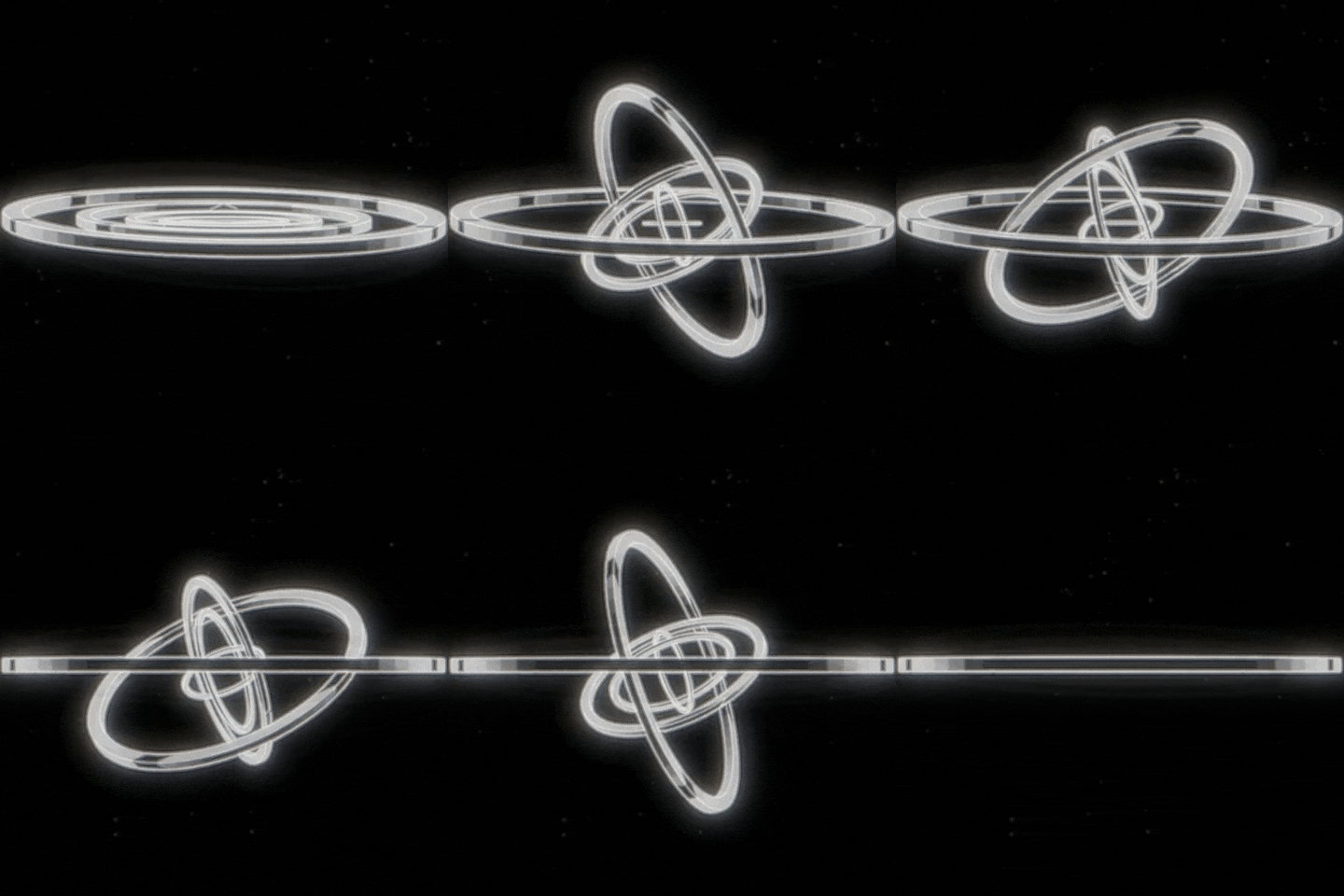
Imaginative concentration, in that sense, is the critical tool for distilling and intensifying the inner conditions that make our intuitive navigation of life possible. It is the fulfillment of an inner preparation that has been eons in the making, and it brings our otherwise complicated ‘soul rotations’ into concentric alignment, as they were originally intended to be when the Gods said, ‘let us make the human in our Image’.
As a helpful comparison, Chess players often speak of ‘focal points’, meaning squares around a player's king that are only being guarded by the king. When we lack a particularly clear strategic vision for a given position, it is helpful to identify these squares. Once we make them an anchor for our attention, our intuitive context shifts - our operational, tactical, and strategic flows begin to align more harmoniously - and thus, certain viable lines for reaching our ideal state of checkmating the king begin to invite our attention. These lines may not involve an immediate attack on the focal points, but simply remaining attuned to this potential weakness in our partner’s position helps us filter the most viable continuations of our mental flow from the space of superimposed ‘storylines’ that could potentially unfold, as we calculate the next moves in the position. In that sense, the concentric alignment of our intents, feelings, thoughts, and sensations allows an unhindered flow of relevant intuitions and imaginations into our state of concentration. When our goal is no longer to complete myopic tasks (like winning a chess game) but to continually expand our orientation within the total flow, the intuitions and imaginations relevant to attaining this goal expand likewise.
Another example of this principle is the phenomenon of ‘strong anticipation’, which is clearly demonstrated in athletic activities. When the baseball player maintains a constant relationship between his visual focus and the ball flying through the air, for example, he doesn’t need to construct mental pipelines to calculate its trajectory and eventual position. Rather, his focused coupling with the ball entrains his imaginative flow, allowing him to anticipate the ball’s trajectory organically and modulate his physical movements accordingly until it meets his glove. That doesn't mean it is an unerring process, but it offers many advantages over ‘weak anticipation’ (mental pipelining) for fostering optimal navigation toward our goal states, particularly in a transpersonal context when we intend our inputs to ripple out beyond our imaginative space into the wider flow (as we explored in the previous part). Benjamin Lyons aptly described the process as follows:
https://interestingessays.substack.com/ ... medium=web
One way of thinking about perception is based on weak anticipation. The idea is that you take in data about the world around you, feed that into your internal model, and use that to produce some picture of the outside world. Call this “weak perception”.
Another way is based on strong anticipation. This kind of perception is about the organism coupling to the environment so that their interactions with it directly perceive information. When a baseball fielder chases a fly ball, they anticipate its trajectory by maintaining a visual relationship with it, not by computing a physics model. There’s no internal model, just direct coupling. As Karl Friston observed, “An agent does not have a model of its world – it is a model.”
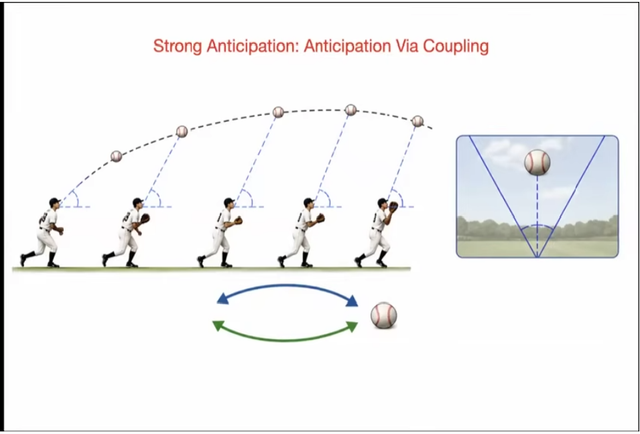
Similarly, anchoring our inner activity at the focal point of imaginative concentration helps us couple with the intuitive environmental context of our present state, which is always implicit in that state, and organically align our otherwise erratic impulses, feelings, and thoughts with this context. Through this alignment, we ‘strongly perceive and anticipate’ occluded aspects of the flow, as well as new possibilities for navigating them. Notice how our attunement to the imaginative feedback in this coupling process is only possible because we remain inwardly active with our ray of attention. We don't allow the inner environment to completely enslave our attention, as if we begin daydreaming about a chess square or the fly ball, but rather actively maintain the coupling between our subflow and the primary flow, as if following a dance partner's lead. In other words, we should preserve a differentiation between our intuitive perspective and its environmental context. As we saw previously, this differentiation of our subflow from the primary is the basis of our imaginative rehearsal space, where we can simulate and rehearse various possibilities for navigating the flow before expressing a particular possibility in speech or deeds.
In that sense, when we concentrate the imaginative state, we also integrate the fruits of ‘weak anticipation’ from our rehearsal space, namely the ability to maintain degrees of freedom in our navigation while coupled with the inner landscape. These degrees of freedom allow us to explore that landscape from many varied symbolic angles and choose among different ways of expanding our intuitive orientation. There is always a bi-directional relationship of influence between our intuitive gestures and the deeper curvatures they navigate, in that sense. We not only passively receive information but also, to some extent, participate in how the deeper curvatures unfold and, to a greater extent, in how its forms can be represented and conveyed to ourselves and others. What we are navigating, however, is not the space of probabilities for where a chess piece can move or a fly ball may land. It is more like the space of psychic probabilities that elucidates why we are more interested in one sport than another, why we desire to spend our time chasing fly balls or attacking squares in chess, why we fashion our mental pipelines into certain frameworks to elucidate the phenomenal dynamics and not others, and similar psychic constraints that can be broadly grouped together as ‘sympathies and antipathies’, as either attractors or repulsors of our flow.
By attuning to the feedback of these deeper constraints, we not only strongly anticipate how particular sensory contents of our state will transform but also how the primary flow will metamorphose our total state along various vectors of imaginative, emotional, and physical experience. The athlete’s state also transforms as a whole, but they are only interested in the immediate sensory feedback; thus, their coupling remains instinctive, and all other factors are ‘averaged out’ in the intuitive background. For example, the athlete's breathing rhythm or mood also modulates their ability to remain visually coupled with the fly ball, but the contributions of these factors are typically felt as negligible. The relationship would become apparent to them only under exceptional circumstances, and only after they reflect on (weakly perceive) those circumstances. In contrast, exceptional circumstances become the new normal in our state of imaginative concentration, and we can strongly anticipate how they are always modulating our present state without building any indirect pipelines about them. In this state, we discover the perfect marriage between weak and strong anticipation (which we also previously described as the convex and concave modalities).
Thus, the method of coupling with the intuitive context in our concentrated state is an inversion of how we manipulate objects in the physical world, such as when we are putting together furniture, or mental images, such as when we are calculating sequences of moves in a game. In these ordinary activities, our perspective is thoroughly convex. It acts as a container for relevant perceptions and memory images, clearly delineating their content and micromanaging their elements (building internal models with mental pipelines). This rigid stance precludes our ability to remain receptive to the incoming flow, as if we were tensing our muscles when someone else is trying to gently massage out their kinks. The inner tension (which can often be felt physically, especially in the facial area or hands) can only be gradually relaxed through consistent inner experimentation with smooth concentration on a unitary symbolic theme. In a sense, we learn to entrust the tensed parts of our psyche and body to a wiser power as we invest all interest and energy into what we are uniquely responsible for within the flow - intuitive coupling through the focal point of attention. That includes our inner commentator who fashions pipelines in the background and mumbles, “entrust the psychic flow to a wiser power… entrust the psychic flow to a wiser power…”, over and over. This commentator also needs to be relaxed and entrusted to the ‘periphery’.
Let’s consider this new method of fully conscious inner coupling through the lens of winning Chess strategy. Once we attain an advantage in a Chess game, for example, if we are up a piece or even only a pawn or two, the surest way to convert the advantage on the board into a win is to trade off the remaining pieces and simplify the game flow. Although there may be many other clever and entertaining ways to move our pieces around and win the game, like we move our mental pictures around when building pipelines in our intellectual inquiries, our results improve dramatically when we remain focused, patient, and stick with the simple strategy of trading pieces. This strategy greatly limits the adversary’s counterplay by depriving them of the pieces needed to mount a viable attack. It also streamlines our tactics and strategy within the game flow, since fewer pieces on the board translate into simpler positions and fewer complicated lines to calculate. It is like we are removing potential attractors of our attention - the various pieces and the complex lines they make possible - from the board state so that our intuitive navigation can more easily attune with its ideal state via a few simple variables - eliminating our partner’s remaining pawns, pushing our pawns to promotion, and checkmating.
A very similar principle applies in the practice of imaginative concentration. When we form the intention to engage in such a practice, we could say we have already attained an ‘advantage’ within the life flow over the version of ourselves that remains ignorant of such a practice or unwilling to engage with it. The latter version is relatively crippled compared to the former and could be considered ‘down a piece’, that is, lacking a critical tool for inner development. This part of our self remains engulfed in an inner landscape with many potential attractors, such as instinctive habits, inclinations, sensuous desires, intellectual topics that we prefer to think about, and so on. Our concentrated self, on the other hand, begins to relax those attractors in the periphery and voluntarily couples its residual activity with the single variable of expanding intuitive orientation within the flow. That is how it begins to convert its advantage. When we take the time to concentrate on the imaginative focal point, it is as if we are trading all the pieces off the inner board, i.e., renouncing our complicated sensations, thoughts, feelings, and impulses, to simplify the flow. Then we are depriving our inner adversary of the ‘pieces’ needed to mount its usual attacks against our concentrated state that throw it off course.
Full essay - https://spiritanalogies.substack.com/p/ ... -chess-81e