Kaje977 wrote: ↑Thu Nov 05, 2026 12:51 am
Cleric wrote: ↑Wed Nov 04, 2026 10:17 pm
If we meditate on these images of lore, we're most likely to fill our imagination with illusory floating images. Then one will say "I see them, I see them!"
This, however, still leaves one completely puzzled about what these beings are, what they do, and most importantly – how they relate to our intellectual ego. The modern example is DMT entities. People speak about them, often with a certain pride about how they penetrated into their world. Yet, in the end, they say, "There are no words to describe any of this." The intellectual ego remains like an alien within these kaleidoscopic states.
Hi, Cleric.
Yes, I see what you mean, and I agree with you, if it were just a matter of passively letting yourself be passively influenced, practically like a drug user. In that case, I see it much the same way you do. On the other hand, there are also works that deal with these beings in a very deliberate manner, in which occult training is undertaken in a very conscious and active way, and which describe in greater detail what these elemental beings do and how they behave, and in the practical way to discover how they relate to our intellectual ego. All of this seems to confuse me abit. Bardon’s work, in "IIH", places a strong emphasis on active, conscious communication with these elemental beings. Let me quote a few relevant passages (note how this is also the last step, step 10, of his work. So this is considered rather difficult at this point, and it's easy to misunderstand what Bardon says as mere fantasy):
Thanks for the quotes, Kaje!
To understand how we are standing in the moment, it might be useful to make a comparison with the time of early Christianity. Let's abstractly imagine the plane between past and future – which is at the same time the division between that which we can encompass in consciousness (we can only encompass the past, what we have already experienced) and the potential future frames of existence.
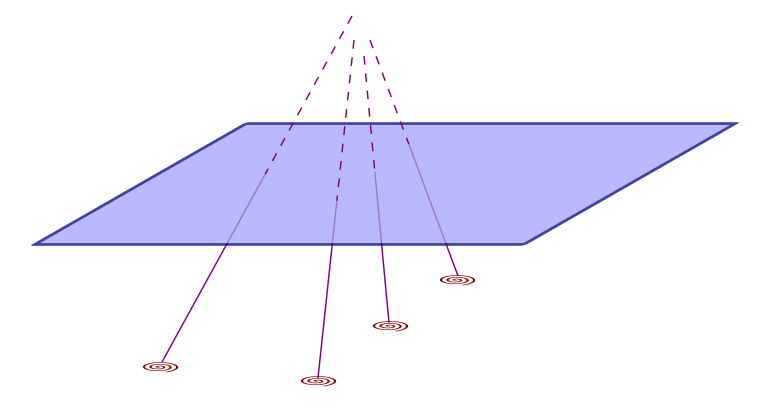
When the early Christians used to read the gospels in the right way for the time, they entered intimate co-experience of Christ's Earthly journey. The words of the gospels were anchors for the elemental moments of existence (symbolized by the spirals) that fit musically within the overarching moment of existence (the passage of Christ through the Earthly states). These souls, however, were humble enough to grasp that these words, these moments of existence, were ones of a Divine Being. They felt the 'lines of sight' passing through these words
converge somewhere much higher (or in the future). The experience of Christ for these souls was to feel aligned in faith and mystical union with the lines of sight, even though they could not experience in clear consciousness the perspective nearer the convergence. They just felt that these words have a mystical center of gravity that is Truth. They felt that there's indeed such a Being, for which these elemental moments are Truthful, just like the memories of our life are truthful to our soul.
With the progress of the intellectual age, however, things were slowly taking the following course:
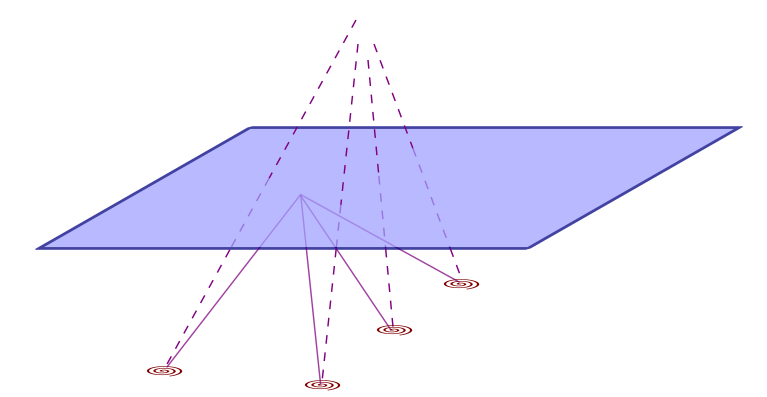
The intellectual ego was becoming more and more emancipated and self-centered. Effectively, this means that the ego positions itself at the threshold and accepts only what it can encompass in its past sensory-intellectual moments of existence. Thus the words of the Gospels were also skewed (seen from an incorrect point of convergence). One could not help but read them through such a sensory-intellectual prism. And even those who still wanted to be faithful Christians had to deal with the changing reality. When the early Christian co-experienced the turning of water into wine, they mystically felt united with a Divine act, whose origin was high in the future. When the later Christian read these words, they could only summon an image of a supernatural act – physical morphing of substances, as it must have appeared to witnessing bodily eyes. And here a conflict brewed – one could simply not witness such moments of existence in the familiar sensory world. Thus, even if they believed them, they stood in somewhat of a conflict with the world experience as we have it. To alleviate this, everything had to be considered more and more like symbols.
If such symbols are taken entirely within the ego's cone, one of two things happens: either they are considered aliases for other sensory-intellectual experiences (a kind of positivism), or they are considered as actual symbols for deeper mysteries, in which, however, the intellectual ego has no place.
The occultism of the last two millennia was secretly preparing the bridge.
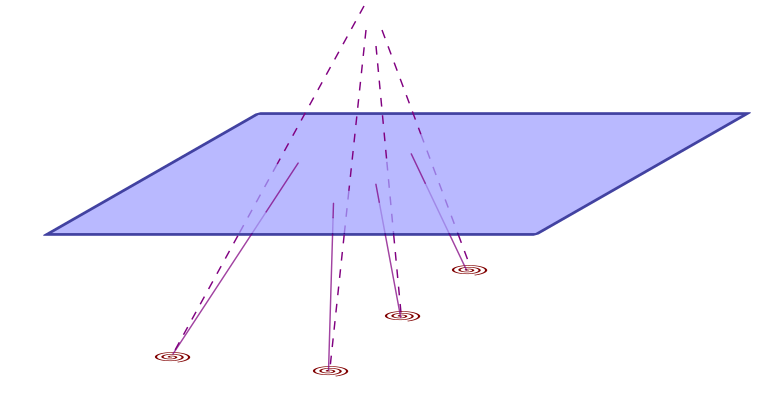
The Initiates were crossing the threshold and, in a sense, could precipitate mental images of moments of existence that made sense only from the corresponding future point of convergence (a higher self). This process was still more or less instinctive. One was fully aware that they were now active within a higher Cosmic Order of Time, yet from thence, only images could precipitate that were taken from the sensory-intellectual conceptual vocabulary (just like the words of the Gospels had to be embodied in the vocabulary of existence of the time).
The second image can be repeated here. Those who try to grasp reality as an assembly of perfectly fitting puzzle pieces can only do that within the cone of the past. This makes sense. If we are to know the perfect picture (the final ToE or MoE), its pixels must already be encompassed. Otherwise, there will always be something missing. With this predisposition, it is only natural that lines of the concepts and images projected from a future point of convergence will be skewed to fit the ego point at the threshold. They will be sought to be understood as assemblies of familiar past moments of existence, which, of course, results in caricatures.
Spiritual Science appears in the stream of evolution to lead man into the future while avoiding the trap of the closure of the ego at the threshold. It would be useless to simply preach to people to return to the old ways and read the gospels like children. The intellectual lines of sight have to find a higher, future point of convergence. To understand SS, we first need to understand that the closure of the ego is an illusory trap. Essentially, we equate ourselves to the point-at-infinity, the Absolute (unknowingly or knowingly - as in the "I am God" philosophy). The true Absolute can be pointed to through the abstract idea of the convergence point of
all elemental lines of sight; all elemental moments of existence are fitting vibrations in this Absolute Chord. When we prematurely say, "I am the Absolute", we secretly imagine that all lines of sight must converge into our
present sense of self. This implies that we deem ourselves fit to understand the secret of existence because all rays already converge within our vantage point. It's only a matter of removing obstructions and segregating the true from the false.
The 'open-coneness' of self-consciousness can be taken as the definition of what a being is. It's a vantage point of existence, whose lines of sight are skewed with respect to the Absolute lines, and thus, were they to be continued until their convergence, would intersect at a point that is offset from the Absolute center of convergence. It can be said that perspectives of being that disrupt the Cosmic order are those who prematurely seek to feel as the Center of Convergence of all (remaining blind about their skewed perspective).
Thus, the second thing is that it is a matter of freedom to seek harmonic alignment with the deeper points of convergence. These are perspectives of Being that are more and more closely approaching the perspective of Absolute convergence. This approach is not achieved by applying control but by opening in prayer. By
willfully imploring that our every next moment of existence that we breathe in, and replaces the previous, is more aligned with the Absolute.
So, spiritual science doesn't simply discard the heartfelt warmth of the Gospels as childish, but saves the intellectual ego from its premature closure and leads it toward the point of convergence from whence the mements of existence depicted in the Gospels begin to make higher sense. Not only as mystical anticipation, but with the same intuitive clarity with which intellectual moments of existence that fit together make sense and lead us into overarching moments of being.
The same thing can be said about occultism of the age of the intellectual soul. The images, such as those you quoted above, are not to be simply discarded as obsolete or incorrect, just like we do not discard the Gospels. Yet, we must also realize that this Hermetic cognition of the last centuries was shaped in specific conditions – in the age of the intellectual soul. We cannot simply adapt the language to the modern age by polishing the words, just like we do not change much by translating the Bible, for example, in modern and thus more accessible English instead of using the forms of the more archaic King James version (this reminds me of attempts ot make the Bible more accessible to modern man by
rapping it

). We understand the Gospels in the true sense by moving toward deeper points of convergence, not by rearranging the elemental moments of existence as they are experienced from our current point of convergence. In other words, our understanding grows not by finding the right-for-all-times concepts and mental images that build the perfect elemental chord from within our present point of convergence, but by progressively growing out of the past moments of existence (which now appear elemental) and grasping everything from within deeper points of convergence. Thus, we understand the Gospels by progressively growing out of the consciousness of the early Christians, then of the medieval thinkers, then the modern thinkers that have stripped the intellectual ego to the bone, and now we must continue further toward a point of convergence that we call the spiritual soul.
What we do here with our descriptions – including the present lines and points of convergence – is certainly not yet full-spectrum esoterism, but allows our intellect to cross the threshold almost seamlessly. In the Hermetic age, the symbols were still, well, arcane. Even the esoterist himself felt that there's a certain
distance (indirectness) between the elemental moment experienced as the symbol and the living experience from whence it is projected. In proper phenomenology, however, this distance gets shorter and shorter. In a way, our intellectual movements become
almost literal expressions of the higher-order dynamics. This is a double-edged sword, of course, because being so intimately close to our intellectual movements, there's also great temptation to encase the mental images in the lower cone and turn them into metaphysics. At the same time, however,
if we are good-willed, there are in fact
fewer ways in which what we speak of here can be misunderstood – precisely because the distance is so short.
This, however, doesn't mean that what we speak of has significance only in the close vicinity of the threshold. In fact, these concepts are of such a kind that we can enter even the Devachan with them and
sustain wakefulness. In the higher Devachanic state, images dissolve; growth-like intuitive metamorphoses cease, but an idea like the contextual moments of existence, lines and convergence, can remain as holistic Intuition. No longer as a mere thought in the head, but as the 'intuitive lattice' of our being, so to speak. If in the embodied state our ego-being feels like a human form, something that speaks and gesticulates, in Devachan we are indeed a perspective of experience of the World flow, relative to the Absolute. Yes, this doesn't in itself give us consciousness of the individual nature of the highest beings, but is nevertheless a state from which we can have a foothold and grow.