
Characteristics of the Spiritual Scientific Method
We previously explored the characteristic dynamics of modern intellectualism, which seeks understanding of the World content through the highly constrained movements of fragmented mental pictures. These constraints are primarily rooted in the soul and subtly guide the intellect to its secretly desired destinations, i.e., its various convictions about the meaning of the content, the origin of the content, its overarching significance, its relationship with other contents, and so on. We hinted that the new spiritual scientific impulse is born when these intellectual ‘spy games’ are honestly and clearly perceived, and the soul then chooses to shift its perspective and interests within the experiential flow, moving orthogonally to the intellectual hamster wheel of opinionation and argumentation. This impulse attracts those who have grown distraught with the comfortable, repetitive, and obstinate habits of the intellect and courageously seek new pathways of intuitive experience to navigate through. It is for those no longer satisfied with matching one set of mental pictures with another and calling the result ‘knowledge’, but rather long to explore how exactly all such imaginative phenomena take shape through deeper intuitive constraints that can be directly experienced.
We can analogize this spiritualizing of the intellect to how Oersted accidentally discovered the magnetic properties of an electrical current at a right angle (perpendicular) to its flow, while completely missing those properties when directly seeking them on the same plane (parallel) as that flow.
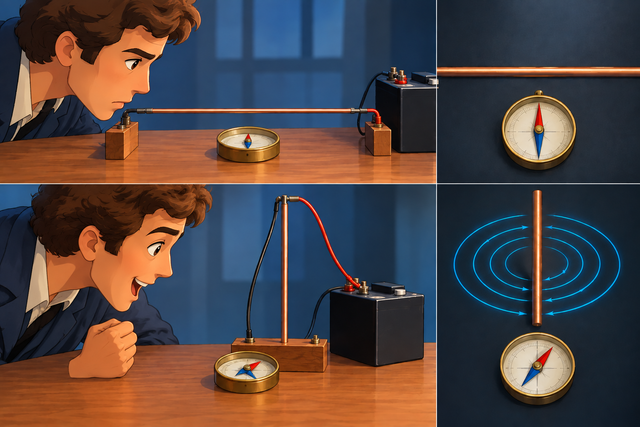
In the history of modern science, paradigm-shifting discoveries have often been made despite the expectations and existing conceptual palette of the discoverers. The former was not linearly extrapolated or deduced from the latter, but arose only when souls accidentally broke the familiar distribution of their inner movements. Similarly, many Anthroposophists, right alongside skeptical critics of Anthroposophy, carry their existing expectations and concepts into Steiner’s indications about physical dynamics, race, skin color, nationality, and so on, treating them as intellectual accounts based on ideas prevalent at the time. They expect to find the meaning of those indications on the same plane as the familiar sensory and cultural-historical flows, fitting neatly into their existing concepts, instead of seeking the meaning at ‘right angles’ to those flows. Unlike the forces detected in the natural sciences, however, the perpendicular inner forces that make spiritual science possible cannot be stumbled into by accident. They can only be sought with full purposiveness, in lucid consciousness. We can clarify this orthogonality by considering why spiritual science, as a unique domain of inquiry in the historical flow, became necessary in our time.
In the last few centuries, scientific effort has tried to grasp space and its contents as they transform. Although “spacetime”, as a unified manifold, has been on everyone’s lips for more than a century, we focus intellectually only on the spatial aspect. We imagine the unfolding of existence as a sequence of space-like snapshots. We do not grasp the “time” in spacetime; instead, we flatten and smear it over these spatial sequences. The intellect devises mathematical relations that try to explain why we observe this sequence of space-like states, and not that sequence. Time thus remains elusive because we insist on seeing it as yet another space-like sequence. The impulse of spiritual science marks the historical point where human consciousness must begin to grow into the “-time” in “spacetime”. The refusal to integrate this evolutionary impulse stems from both science and religion denying that human consciousness can expand into reality’s temporal curvatures. When they don’t deny that possibility outright, they still expect the latter to be seen like any other space-like phenomenon. Perhaps seeing time is like seeing some new exotic shapes and colors? Although this possibility has been staring us in the face for many years, it still isn’t taken seriously, even by many spiritual seekers.
Most modern souls still expect and demand to see the temporal curvatures as space-like objects before stepping directly through their metamorphoses. When that expectation is unsurprisingly disappointed, seekers imagine that experiencing the reality of Time must wait until unspecified future conditions make it more favorable. They keep approximating Time with intellectual patchworking and abstract placeholders, hoping to find the ‘true reality’ of spiritual scientific communications at some continually postponed future date, like the donkey chasing the carrot tied to its head. The temporal forces immanently implicit in their intellectual gestures continue to elude those gestures, always remaining just out of reach. For the same reason, the skeptics imagine that the experiences described have always been a chimera. If not outright hallucinations, then a theoretical metaphysical system that offers only a certain degree of coherence and satisfaction, but that could easily be replaced by other systems. They wonder why, if all the talk of ‘clairvoyance’ speaks of something concrete and real, it is nowhere to be found amongst the general population. These misorientations all result from trying to grasp what is truly temporal only through well-worn intuitions rooted in spatial life.
Instead, we can consider that our experiential volume, which normally feels as the transforming phenomena closely circumscribing our bodily volume, is not only a volume of space but of spacetime. If the familiar spatial volume can ‘feel like’ something, why can’t the expanded temporal volume also feel like something? Modern science dimly intuits this possibility through the other seminal development of 20th-century physics: quantum mechanics and the concept of the ‘wavefunction’. For our purposes, that concept symbolizes more integrated domains of potential experience. It speaks to the manifold possible ‘storylines’ that are always influencing our feelings, thoughts, and actions in lawful ways. Unlike in QM, however, we are under no illusion that we can calculate and predict these possibilities with fixed formulas. Rather, they symbolize much more organic, incalculable relations between spiritual beings that shape the flow of our daily life experiences. Our experience of ‘calculating and predicting’ is itself a possible continuation of our existential story that exists by virtue of the organic relations of spiritual intents.
As a metaphor, imagine walking down a busy city street. Although our vision points straight ahead, we feel that we are crossing many buildings in the periphery and, if it is a familiar street, we have some sense of what those buildings are (shops, restaurants, banks, etc.). This feeling would not simply be of more spatial objects like the cars, signs, other people, etc. that cross into our direct line of vision, but each peripheral building feels like a domain of potential experience that is slightly tugging on our attention, some exerting a more intense attraction than others. At any point, the tugging may reach a tipping point at which we zoom into the peripheral potential by focusing more closely on the buildings, beginning to form more specific thoughts about what experiences they offer and how they relate to our goals for the day, week, etc. Then these thoughts may accumulate to the point that they guide our bodily will to deviate from navigating the street, enter a particular shop, and fully collapse that potential into concrete shop experiences. Our ordinary intellectual life resembles this collapsed shopping experience, whereas something similar to navigating the street potential can unfold in our intuitive life at a more integrated scale.
It is as if, instead of only dimly sensing the buildings in the periphery, this landscape of potential becomes the new temporal environment we lucidly steer through. It is not like steering through all the various sensory experiences offered by the shops, but rather like steering through the soul forces that bring those experiences into a sympathetic or antipathetic relationship with our perspective. These ‘forces’ are not additional objects in space, like energetic currents or fields, but symbols for relatively persistent tendencies that always push and pull our attention, making certain continuations of our first-person state more likely than others. We may be attracted by a sympathy for shiny gadgets that mostly took shape in childhood, for example, while also repulsed by an antipathy toward a cuisine shaped a few years ago when we went through a bad case of food poisoning. In that sense, these persistent tendencies link us with distinct, yet overlapping phases of our temporal development. We can also heighten attention to this dynamic, especially as we get older, by contemplating how our previous activity still influences our present physical state.
For example, as we walk down the street, we could try to feel how various physical gestures, movements, and qualities can be intuitively traced to those prior inputs. Perhaps we feel a rumbling in our stomach that traces back to our decision to eat or not eat certain foods a few hours ago. Then we may also feel soreness in our knees that traces mostly to physical activities we engaged in excessively or recklessly a few years ago. The way we walk, our gait, our posture, etc., can similarly trace back to prior intents and corresponding gestures, perhaps dating to early childhood. We could feel our whole present physical state as a kind of tree with rings laid down at different times, in correlation with prior inputs. Of course, all of that would initially feel dim and nebulous. The point is to simply accustom ourselves to shifting our scientific perspective. The important thing here is not to reach quantifiable models of how our inner activity relates to the observed outputs, as if we can calculate exactly how a certain constellation of inner gestures led to our sore knee, but to gradually accustom ourselves to a new way of feeling the relationships and temporally expanding our orientation to them.
Once we grow more sensitive to the temporal thickness of our present state, it becomes evident how the sympathies and antipathies that attract and repulse the possible continuations of our flow are overarching temporal curvatures that steer and shape a wide range of life experiences. We realize how these organic soul constraints elucidate much of our life trajectory, and likewise the trajectory of the Earthly environment as a whole, instead of trying to explain that trajectory with fantasized external mechanisms. These temporal soul constraints no longer feel like they ‘belong to us’, as our non-spatial experiences normally do, but more like autonomous agents that have sculpted our bodily and soul organization across many phases of development. Is it so much different for the ‘tree rings’ of collective life that come to expression in various physical dynamics that we try to model, for example, as weather phenomena and natural disasters? In the age of powerful technology, it has become even more obvious how humanity’s collective inputs influence these natural phenomena, with progressively less delay. Yet those technologies are themselves obviously extensions of our intuitive life and its soul constraints.
Thus, we unconsciously resist expanding into Time primarily because the temporal curvatures of the spacetime flux feel like intuitive, willful intents related to our intimate sense of who we are and what we are doing in life, as individuals and collectives. To know the shape of Time is to know the intents that shape the existential flow from within. For example, when we intend to move from the bedroom to the kitchen, we intuitively sense how most of our perceptual states, including our emotional and mental states, are closely correlated with that intent. As we physically move through the house, the tactile, olfactory, visual, and auditory sensations shift, and, perhaps to a much lesser extent, our emotional and imaginative perceptions (thoughts) subtly shift as well. If we wanted to ‘explain’ these transformations, the most direct way would be to feel the ‘texture’ of our underlying intent more intimately; to live in its unfoldment more consciously and intensely, observing how every slight inner gesture is coupled with perceptual shifts. And if we wanted to ‘explain’ the phenomenal transformations that don’t feel directly correlated with our intent, like the sound of thunder we hear outside, the most direct way would be to expand our consciousness through the temporal curvatures in which our present intent is concentrically nested.
Full essay -https://spiritanalogies.substack.com/p/ ... ifying-385