Here, he is, of course, describing the second will exercise - the one where you basically choose something simple to do each day, which could be clapping your hands at 12 o'clock each day, or watering plants at a certain time, or something like that. The idea I have of this is that elemental beings are spirits who live etherically within the physical elements (e.g. fire, or air) and perhaps give them their distinct inner qualities. Am I getting the right idea? What do they have to do with sensations as Steiner is describing there? I know at least that the etheric body is where we experience physical sensation and it somehow translates intention and will from the "I" and astral-body into physical movements.Through this awakening etheric body, we gradually learn to experience ourselves in the etheric world. In reality, every time we move - for instance, if I grasp an object or knock against it - this is an attack on the outer world. The non-esotericist has no inkling of this, for he is protected from such knowledge by the Guardian of the Threshold; but the esotericist gradually makes his etheric body independent, so that it experiences itself in the etheric world. His organs become more sensitive, and he increasingly acquires a sense of the fact that every space is filled not just with physical objects, but with a countless number of elemental beings who make themselves felt through pricking, prodding and burning. In this elemental etheric world, one has to make space for oneself everywhere through will impulses such as stretching, withdrawing, pushing, walking forwards, etc., and such movements must occur with the full awareness that one wishes this out of one's inmost being. That is the second thing: initiative in actions. Someone who cannot make space for himself in this etheric world through his initiating will can achieve as little in this world as someone in the physical world who tries to dance on a stage crowded with chairs. First, the chairs have to be removed. The second exercise teaches us how to do this in the spirit.
Anthroposophy for Dummies
Re: Anthroposophy for Dummies
It's been a while since I last posted on here, but I hope everybody is doing well. I am just wondering if anyone understands what elemental beings are? Steiner mentions them sometimes, but it still isn't clear to me what they are actually are. For instance, here in this lecture excerpt (from Six Steps in Self-Development: The 'Supplementary Exercises') he says:
Re: Anthroposophy for Dummies
I'm not exactly sure what Steiner is referring to specifically, but elemental beings are generally considered to be the beings that directly shape the mineral and animal kingdoms. There are many different kinds of these beings, but the term "elemental beings" usually refers to salamanders, sylphs, undines, and gnomes which have a formative influence on the four elements. (As far-fetched and fantastical as it may sound at first, these beings are very real)LukeJTM wrote: ↑Tue Nov 03, 2026 2:32 pm It's been a while since I last posted on here, but I hope everybody is doing well. I am just wondering if anyone understands what elemental beings are? Steiner mentions them sometimes, but it still isn't clear to me what they are actually are. For instance, here in this lecture excerpt (from Six Steps in Self-Development: The 'Supplementary Exercises') he says:
Here, he is, of course, describing the second will exercise - the one where you basically choose something simple to do each day, which could be clapping your hands at 12 o'clock each day, or watering plants at a certain time, or something like that. The idea I have of this is that elemental beings are spirits who live etherically within the physical elements (e.g. fire, or air) and perhaps give them their distinct inner qualities. Am I getting the right idea? What do they have to do with sensations as Steiner is describing there? I know at least that the etheric body is where we experience physical sensation and it somehow translates intention and will from the "I" and astral-body into physical movements.Through this awakening etheric body, we gradually learn to experience ourselves in the etheric world. In reality, every time we move - for instance, if I grasp an object or knock against it - this is an attack on the outer world. The non-esotericist has no inkling of this, for he is protected from such knowledge by the Guardian of the Threshold; but the esotericist gradually makes his etheric body independent, so that it experiences itself in the etheric world. His organs become more sensitive, and he increasingly acquires a sense of the fact that every space is filled not just with physical objects, but with a countless number of elemental beings who make themselves felt through pricking, prodding and burning. In this elemental etheric world, one has to make space for oneself everywhere through will impulses such as stretching, withdrawing, pushing, walking forwards, etc., and such movements must occur with the full awareness that one wishes this out of one's inmost being. That is the second thing: initiative in actions. Someone who cannot make space for himself in this etheric world through his initiating will can achieve as little in this world as someone in the physical world who tries to dance on a stage crowded with chairs. First, the chairs have to be removed. The second exercise teaches us how to do this in the spirit.

Re: Anthroposophy for Dummies
LukeJTM wrote: ↑Tue Nov 03, 2026 2:32 pm It's been a while since I last posted on here, but I hope everybody is doing well. I am just wondering if anyone understands what elemental beings are? Steiner mentions them sometimes, but it still isn't clear to me what they are actually are. For instance, here in this lecture excerpt (from Six Steps in Self-Development: The 'Supplementary Exercises') he says:
Here, he is, of course, describing the second will exercise - the one where you basically choose something simple to do each day, which could be clapping your hands at 12 o'clock each day, or watering plants at a certain time, or something like that. The idea I have of this is that elemental beings are spirits who live etherically within the physical elements (e.g. fire, or air) and perhaps give them their distinct inner qualities. Am I getting the right idea? What do they have to do with sensations as Steiner is describing there? I know at least that the etheric body is where we experience physical sensation and it somehow translates intention and will from the "I" and astral-body into physical movements.Through this awakening etheric body, we gradually learn to experience ourselves in the etheric world. In reality, every time we move - for instance, if I grasp an object or knock against it - this is an attack on the outer world. The non-esotericist has no inkling of this, for he is protected from such knowledge by the Guardian of the Threshold; but the esotericist gradually makes his etheric body independent, so that it experiences itself in the etheric world. His organs become more sensitive, and he increasingly acquires a sense of the fact that every space is filled not just with physical objects, but with a countless number of elemental beings who make themselves felt through pricking, prodding and burning. In this elemental etheric world, one has to make space for oneself everywhere through will impulses such as stretching, withdrawing, pushing, walking forwards, etc., and such movements must occur with the full awareness that one wishes this out of one's inmost being. That is the second thing: initiative in actions. Someone who cannot make space for himself in this etheric world through his initiating will can achieve as little in this world as someone in the physical world who tries to dance on a stage crowded with chairs. First, the chairs have to be removed. The second exercise teaches us how to do this in the spirit.
Hi Luke,
One way to approach elemental beings is to consider the persistent tendencies that we mentioned in the other thread. Steiner has mentioned that every mental image we condense from the intuitive potential of existence can become incorporated into the perspective of an elemental being. However, if we imagine these as little entities roaming around in space, we are on the wrong track. Our thoughts don't exist in discrete spatial locations, either left or right of our perspective, yet they often constellate patterns that repetitively draw our attention back to their content. We call the relatively stable patterns opinions, beliefs, outlooks, and ideologies (in contrast to a melody that gets temporarily 'stuck in our head', for example). In ordinary consciousness, we have very little awareness of these patterns and how they shape our perception, understanding, and actions within the flow. Even the persistent melody continues to bounce around in our imagination when we are unaware of it. With higher development (via guidelines indicated in the esoteric lessons, for example), we become much more sensitive to the existence of these patterns and how they influence our soul and physical flows (the latter are felt as more and more overlapping, like two sides of the same coin). These persistent tendencies become like an overarching context that tightly constrains the potential transitions of our first-person state to new states. Of course, not all tendencies are unhealthy, as they serve important stabilizing functions in our experiential flow. For instance, we rely on repetitive inner tendencies to perform routine mental and physical operations without relearning the relevant inner gestures each time.
In the domain of 'outer' nature, we are dealing with persistent tendencies at a deeper scale that took shape many epochs ago. In other words, here we are dealing more with the collective karma of humanity that still carries momentum from prior ages. These are symbolized by the elemental beings associated with the core elements and the 'laws of nature', as the intellect perceives the latter. They are generally healthier patterns that provide critical support for our intuitive steering through the constraints of sensory life. However, if we remain too dependent on these natural patterns to direct our soul life, we devolve into a more animalistic mode of existence. In that sense, "elemental" generally symbolizes receded spiritual activity that has settled into relatively persistent, repetitive patterns. That contrasts with "archetypal" spiritual activity, which remains, from our ordinary perspective, in a state of potential, with flexibility and leeway to take different paths toward goal states. Insofar as the receded patterns create the conditions for a compounding memory flow (not necessarily how we experience memory images constrained by the physical organism), we can speak of coherent perspectives or "beings". In other words, we speak of "beings" when there is continuity of awareness and some sense of more or less consciously steering the experiential flow toward certain goal states. These beings may not have any sense that they unfold their activity within the context of a wider human organism that is steering toward its (hopefully) less myopic goal states.
Again, it is important to understand that no separate "elemental beings" exist in some part of space as discrete (but subtle) entities that create these repetitive tendencies; rather, our first-person experience of differentiated tendencies is all there is, and we artistically symbolize their differentiated influences with names like demon, phantom, egregore, etc. in the soul life, or gnomes, undines, etc. in physical-sensory life. This is how all esoteric terminology originally took shape, but since the modern intellectual perspective has become so tightly conditioned by its spatial intuition, it often imagines these beings as subtle entities existing 'side by side' with other spatial objects. That inevitably leads us to conceive of these entities and their influences as independent of our first-person soul flow, which then raises irresolvable questions about what they are, where they come from, how they create the elements, and so on. We are only safe when we strive to understand all spiritual scientific terminology as artistic expressions of the lawful patterns we intuitively discern through our first-person lived flow of experience along the scales of existence. That becomes possible only when we strive to become more conscious of the scale-axis through meditative exercises, otherwise we remain tightly merged with the intellectual-sensory scale and all talk of spiritual beings necessarily remains as abstract, floating puzzle pieces.
"They only can acquire the sacred power of self-intuition, who within themselves can interpret and understand the symbol... those only, who feel in their own spirits the same instinct, which impels the chrysalis of the horned fly to leave room in the involucrum for antennae yet to come."

Re: Anthroposophy for Dummies
Hi Luke, here's one more angle on the question.LukeJTM wrote: ↑Tue Nov 03, 2026 2:32 pm Here, he is, of course, describing the second will exercise - the one where you basically choose something simple to do each day, which could be clapping your hands at 12 o'clock each day, or watering plants at a certain time, or something like that. The idea I have of this is that elemental beings are spirits who live etherically within the physical elements (e.g. fire, or air) and perhaps give them their distinct inner qualities. Am I getting the right idea? What do they have to do with sensations as Steiner is describing there? I know at least that the etheric body is where we experience physical sensation and it somehow translates intention and will from the "I" and astral-body into physical movements.
When we think about elemental beings, we usually employ mental imaging similar to what we use when we picture atoms. Except, with elemental beings, we tend to imagine more alive atoms. This, however, doesn't lead far. What we do is simply take replicas of visual experiences as we know them from our bodily life, and fill the canvas of imagination with them.
A more difficult-to-follow (demands certain meditative effort), but more fruitful direction can be presented in the following way. Let's try to loosely conceive of the potential of what existence could be – not what existence can be as if looking at it from above, as some perceived process, but as first-person existence. It is as if we try to superimpose other humans' first-person inner life over ours. The overlaid sensations will feel like blurry noise, but still, there are some commonalities. For example, all these sensations would still feel like they fill a more or less human-like shape experienced from within. This gives us an idea of what is meant by saying "what existence could be". Now we should simply continue this mental exercise further and expand until we include all the infinite variety of forms of existence. Notice, we do not ask what outer worlds/environments can support such experiences of existence. We focus entirely on the innerly experienced shape of existence. If we move in this direction asymptotically, we can imagine that we approach something like bright light that fills the infinite experiential space – a symbol not only for visual experience but for the full spectrum of what might be possible for experience.
Now we can think the opposite way. Starting from this infinite and unconstrained potential of what a moment of existence could be, how do we filter a differentiated one out? To understand this, we can use a metaphor with mathematicians. They are so engrossed in thier ideas that they have lost awareness of embodied existence. They live entirely in mathematical intuition and try to figure out the mystery of existence. Each has their own idea. However, they are so invested in that idea that it could be said it is the shape of their being. They are not human beings who arrange mathematical objects in their mind. They have left that behind while they were sinking into deeper and deeper meditation. Now one may feel something like, "I am two-foldness. The mystery of existence feels to me as composed of polarities."
Now the other mathematicians represent alternative ideal perspectives. Another one may feel that everything consists of triples, and so on. However, these perspectives are not external beings that carry their own thoughts in their heads. Instead, these ideal shapes of first-person existence are as if superimposed, just like we can have alternative theories in our mind. They are alternative prisms through which the infinite potential can be delineated. Except, I repeat, these mathematicians don't use their number intuitions to make pictures of an outer world. It is their innermost I-ness that has that shape. And the intuition of what we are is at the same time the intuition of what existence is. This is true even in ordinary life. When the materialist says "I'm just a material brain", the ego indeed tries to feel itself in the shape of a brain.
Let's say that there are twelve mathematicians with twelve thories. Unlike arrogant human beings, they do not fight to prove whose perspective is right. They feel that perspectives exist in the first place because they are incomplete. They are like different angles for intuiting the mystery of existence, yet, as we align with one angle, we feel that we cannot reconcile with the others. The mathematicians seek to attune their perspectives, as if to see through all twelve at the same time, thus becoming one. This answers the Question in the only way it can satisfy a being – to know the potential for existence is to merge with it, which means to evolve out of the relative perspectives by finding what they have differentiated from.
Thus, one mathematician feels that there are twelve complementary viewpoints on the great mystery. In fact, the mathematicians are the viewpoints (they are not some distinct beings that have a subjective viewpoint). So what does one viewpoint experience? The superimposed intuition of the others. For example, the two-ness wants to feel what its experience is a two-ness of. It's two-ness of the intuition of all other n-nesses. But then, if we continue and look into one of these n-nesses, what is it made of? The intuition of all others that complement it. And so on. A nice metaphor for this is the fractal, even as simple as the Sierpinski triangle. There we can ask, "What is it made of?" Well, out of copies of itself. But what are the copies made of? We see how we can never reach a fundamental atom. All we have are relations of the Unknown. It's similar with our mathematicians. Existence can be anything. But then, it is as if we say: "I don't know what existence is or could be, but let's consider that there could be twelve complementary viewpoints on that mystery." None of these viewpoints sees the essence of the mystery (just like we don't see what the fractal is made of), but grasps the recursive relations into which such viewpoints can be experienced. Why twelve? It's just an example. It's just a fractal seed. Others will give possibilities for different relations of the Infinite.
So these recursive perspectives are not simply static forms, but moments of becoming. From the mathematician's perspective, they are only possibilities – what existence could be intuited as. Yet they invite the possibility - what if my moment of existence can be followed through the prism embedded deeper in the recursive relations? Through particular detuning (just like the twelves are detuned from the One), it is possible that the recursive relations are dephased in such a way that they form strange interference patterns. Remember https://www.shadertoy.com/view/XfSXRG
This is important to grasp. In a sense, we are not geometrically partitioned beings, like fractal cells of the recursion. We are still one with the mathematician's perspective, or even the One toward which all strive, but the recursive reflections become so complicated that the initial clear intuition is obscured, and now at the forefront comes the interference, similar to Moiré patterns. Just like the twelve, this dephasing has a beginning and resolution. It's rhythm within rhythm.
So what are elemental beings? We can understand them in a truthful way only when we approach the mathematician's perspective. Consider a path that can be potentially traced as we follow the reflections. Each such path can be a unique sequence, as if it were a different way of following the reflections. It's like saying "The two-ness that I am is made of three (and others), which is made of seven (and others), ..." These different ways of following the reflections give the sense of multiplicity, because the deeper we go, the more alternative sequences we leave around. An elemental being can be thought of as one such zooming path. It is elemental because, in a way, it is like infinitely many elemental 'pixels' that constitute the intuition of the mathematician's perspective. Yet, from that perspective, there's no question of believing that these are some fundamental entities that build up reality from the ground up. Instead, these are the infinite elemental perspectives that can be traced when we start with a certain n-ness of the Unknown. They are 'beings' because when these elemental perspectives are traced, they feel like something, even though not having self-reflection.
I know this is a lot, and open to many misunderstandings, but I hope it at least gives an indication about the inner stance that we must assume if we are to have proper relation to these questions. For example, if we now simply imagine such vortices sinking into the infinite multiplicity, we are still nudging Moiré patterns of which our everyday images consist. But if we stare deeply into the experience of, for example, an infinitesimal point of color, we may say: "This color point is the limit at infinity where the intuition of the mathematician (in whose consciousness my aliased human experiences are embedded and dephased) sinks when the reflections are followed in a certain way." Just stating that intellectually doesn't make it reality, but it is something that we can meditate on.
So what Steiner says fully corresponds to the facts. Our inner perspective is woven of these intuitive paths sinking into the infinite multiplicity. There're no empty spaces. Everything that we experience as phenomena is, in a sense, an elemental 'line of sight' of a higher perspective. And correspondingly, these lines of sight can be traced back toward their higher origin. The different classes of elemental beings originate at different levels of Moiré interference. What we have described, which emerges from the highest perspectives, can be thought of as the warmth elemental lines of sight.
Re: Anthroposophy for Dummies
Somehow the descriptions you two provided sound very abstract and impersonal, as if these beings were more like "particles". I realize that I'm misunderstanding something here (or perhaps you were referring to elemental beings in general), but there must be a reason why many occult authors often refer to these elemental beings as "gnomes", "undines", "sylphs" and so on. We find similar descriptions from other cultures as well that seem to match what we would call "undines". There are also many occult testimonies in which these realms are explored in depth, including some theosophical works such as *The Kingdom of Gods*: https://www.theosophy.world/books/geoff ... rey-hodson
Perhaps I’m misunderstanding something here, but quite many were capable of communicating with these beings (most of them adepts, not just initiates), of course "communication" meaning something entirely different than the habitual sensual-thinking mode. I don't know, but the poetic and artistical aspect seems to be missing here, or I just haven't been through the stages yet to make clear of what you both mean.
Perhaps I’m misunderstanding something here, but quite many were capable of communicating with these beings (most of them adepts, not just initiates), of course "communication" meaning something entirely different than the habitual sensual-thinking mode. I don't know, but the poetic and artistical aspect seems to be missing here, or I just haven't been through the stages yet to make clear of what you both mean.
Re: Anthroposophy for Dummies
Kaje, I agree that the descriptions sound abstract, but this is only because these are the concepts from which the intellect can rediscover the elemental world, although in new ways. The designations of gnomes, elves, etc. certainly give a warm feeling (to those predisposed). It takes us back to the times of old when people could still feel that Nature was alive, that the elements had their living presence and character, and so on. But today, the human "I" has been stripped to the bone, so to speak. If we meditate on these images of lore, we're most likely to fill our imagination with illusory floating images. Then one will say "I see them, I see them!" This, however, still leaves one completely puzzled about what these beings are, what they do, and most importantly – how they relate to our intellectual ego. The modern example is DMT entities. People speak about them, often with a certain pride about how they penetrated into their world. Yet, in the end, they say, "There are no words to describe any of this." The intellectual ego remains like an alien within these kaleidoscopic states.Kaje977 wrote: ↑Wed Nov 04, 2026 7:44 pm Somehow the descriptions you two provided sound very abstract and impersonal, as if these beings were more like "particles". I realize that I'm misunderstanding something here (or perhaps you were referring to elemental beings in general), but there must be a reason why many occult authors often refer to these elemental beings as "gnomes", "undines", "sylphs" and so on. We find similar descriptions from other cultures as well that seem to match what we would call "undines". There are also many occult testimonies in which these realms are explored in depth, including some theosophical works such as *The Kingdom of Gods*: https://www.theosophy.world/books/geoff ... rey-hodson
Perhaps I’m misunderstanding something here, but quite many were capable of communicating with these beings (most of them adepts, not just initiates), of course "communication" meaning something entirely different than the habitual sensual-thinking mode. I don't know, but the poetic and artistical aspect seems to be missing here, or I just haven't been through the stages yet to make clear of what you both mean.
That's why we try to start from what is immediate reality for the modern man and grow from there. The words in our posts remain abstract only as long as they are seen as an attempt to metaphysically and intellectually reduce reality to 'elemental particles'. Then one says, "If I am to reduce reality to anything, I would rather reduce it to more alive, creature-like particles, with temper, personality, etc."
Let me give another example in the lines of Ashvin's post. The abstract intellect can think of its existence as composed of 'first-person moments of existence'. They are not only sequences of equal amounts of time, but contextual moments. Anecdotally, we say, "Just one moment..." and go on to finish what we are doing before switching to the other person. This 'one moment' is overarching many lesser moments of becoming.
Now imagine that we focus on one such moment (of a certain length) and begin to strip it out of its context. In the end, it is like a short first-person movie clip of existence that flashes, but there's no intuition about how it is connected to a larger plot. It's literally like being shown two seconds of a movie. The clip may have its character and elemental meaning, but it is severed from a larger context. The intuitive context that unites such elemental clips into a greater plot is what we call ego/I. We say, "these elemental movie clips constitute the movie of my life."
Now let's think about a concrete example. Let's say we pronounce a curse. This is a moment of existence. In former times one may say that we have been momentarily snatched by a demonic elemental being. From our first-person perspective, however, this elemental being is the clip of the curse severed from the wider context. If today's intellectual man tries to see a horny little devil, they'll just fall in for the true elemental demon – it's the moment of existence that feels like a flash of a fantastic picture. Do you feel what just happened here?
When through concentration we seek to make all moments of existence, from the smallest to the greatest, concentric, we begin to sense how these moments of existence fight for our attention. We begin to feel that inner space is teeming with such moments of existence that fight to take the central place, to become our next moment of existence. They are not merely mechanical. When we resist them, they show their temper. There's a force that seeks to make these elemental moments our moments. Because it is only when these moments are aligned with a self-reflective consciousness that they receive their own elemental sense of existence. In a sense, we give them our ego, so that for a moment they can have an elemental flash of self-consciousness. And there are greater centers, having a greater attention span than our ego, that seek to experience such moments of existence. For them, the human ego feels like a stubborn moment of existence that they continually try to align with their higher one, and thus, be able to experience also the lesser elemental moments through it. A cursing person continually gives way to these elemental moments of existence, and they give the higher center the means of self-reflection. It says, "Now here's something in which I can recognize my own nature!"
So we see – we speak abstractly about moments of existence, spacetime intervals of different scales, etc. But it is precisely through such concepts that we can find the proper relation to these elemental moments of existence. Then it is up to us to seek and align with the higher center that finds its self-reflection in a flow of elemental moments that are True and Good. The untruthful moments of existence build up a limited sphere, a special kingdom in which these off-center centers want to have their self-reflection. Now think about it: sure, it may sound abstract, but does this way of looking at things actually give us a better understanding of how to relate to the elementals? Would we better know what to do and what the nature of reality is if we simply feel 'presences' and images overlaid on the perceptual aspects of Nature?
Re: Anthroposophy for Dummies
Hi, Cleric.Cleric wrote: ↑Wed Nov 04, 2026 10:17 pm If we meditate on these images of lore, we're most likely to fill our imagination with illusory floating images. Then one will say "I see them, I see them!" This, however, still leaves one completely puzzled about what these beings are, what they do, and most importantly – how they relate to our intellectual ego. The modern example is DMT entities. People speak about them, often with a certain pride about how they penetrated into their world. Yet, in the end, they say, "There are no words to describe any of this." The intellectual ego remains like an alien within these kaleidoscopic states.
Yes, I see what you mean, and I agree with you, if it were just a matter of passively letting yourself be passively influenced, practically like a drug user. In that case, I see it much the same way you do. On the other hand, there are also works that deal with these beings in a very deliberate manner, in which occult training is undertaken in a very conscious and active way, and which describe in greater detail what these elemental beings do and how they behave, and in the practical way to discover how they relate to our intellectual ego. All of this seems to confuse me abit. Bardon’s work, in "IIH", places a strong emphasis on active, conscious communication with these elemental beings. Let me quote a few relevant passages (note how this is also the last step, step 10, of his work. So this is considered rather difficult at this point, and it's easy to misunderstand what Bardon says as mere fantasy):
And another part of the text:Before the magician begins to follow the practice of the tenth and last step of this course, he may look back attentively and make sure that he achieved the positive realization of all he has been taught up to now. If that is not the case, he must try to make up for all he is still lacking and must go to any length for developing every faculty completely. Any kind of haste or hurry with respect to his development is useless and will work out awkwardly later in his magic task. To avoid disappointments, the magician is advised to take a sufficient amount of time and to work steadily but systematically. He must realize that this last step really represents the end of his magical development with respect to the first Tarot card and that he ought to be prepared for the higher magical tasks that I am going to describe in the following two works: The Practice of Magical Evocation and The Key To The True Quabbalah. If there were gaps in his schooling, he would never be able to control the higher Powers. It is certainly not important whether he will finish his course a few months sooner or later; the main point will always be to keep his aim in mind and to advance steadily to the goal, the lofty heights of God-cognition. Looking back to his actual development, the magician will realize that he has already covered a good distance on the path of his perfection, even more than he had supposed to, but he has to know that all this is but the thin edge of a wedge. Meditating on the fact how much knowledge and experience he has still to store, he will bow in a spirit of great reverence in front of the Divine fount of Wisdom.
There will be no more pride or ambition nor superciliousness, to say nothing of bad qualities in his heart, for the deeper he penetrates into God’s workshop, the more humble and receptive he will become. The first task that the magician is facing in the tenth step is to win his way to the knowledge of the sphere of the elements. With his mental body he will visit the different spheres of the elements, transfer himself to the kingdom of the gnomes, or earth-sprites, afterward to the kingdom of the water nymphs. He gets to know the kingdom of the fairies and finally that of the salamanders, the so-called kingdom of fire. To a non-magician all this will be rubbish and he will regard it as a utopian idea. But neither fairy tales nor sagas exist for the true adept, because they are to be understood as a sort of symbolism concealing many deep truths. It is the same thing with all the gnomes, nymphs, fairies and salamanders. Based on his own observations, the magician can convince himself that beings like these really do exist. On the other hand, a magically untrained person whose senses are thoroughly undeveloped is of course subject to the vibrations of the material world only and will never be able to form a mental picture of the existence of any other kind of beings, to say nothing of being convinced of this fact. Most people are preoccupied by the material mode of life to such a degree that they will not understand anything higher and subtler outside our physical world and least of all will they perceive it. It is quite otherwise with a magician who is developing his senses purposefully and therefore will see and perceive far more, convincing himself very soon of the existence of higher powers, planes and beings. Properly speaking, it is the goal of our training to qualify the learner to perceive and to master not only the physical world but the higher spheres equally. But let us stick to the practice and consider what can be done to reach the world of the elements.
In the previous chapters we learned that there is a kingdom of elements populated not only by the element itself, but by the corresponding beings too. Then what is the difference between a human being and an elemental being? The human being consists of four and five elements respectively, and is ruled by them, whereas an elemental being is composed of the purest element to which it belongs. According to our estimation of time, the duration of life of such a being probably is longer, but it has no immortal spirit. As a rule such a being is resolved into its element again. Let us disregard the description of details for a while, because the magician will learn everything by practical experiences. He will be able to do so by transference of his spirit. The magician is bound to understand how to transfer himself to the kingdom of the elements to contact the beings there. Later he will even manage to rule over these beings.
First of all, the magician has to realize that the kingdom of the elements has nothing to do with our material world and that consequently he cannot transfer himself there without being qualified to do so. On the other hand, an elemental being can come to an understanding only with a congener, a fact that ought to be considered most carefully. A bird is well matched only with another bird. In the same way, an elemental being will have an understanding only with a congeneric being, i.e., a being of the same element. Provided it should like to come in contact with another being, it would be bound to adopt a human form and human qualities to approach man in the form of man. At this point the magician will realize why he had to perform transmutation exercises in the previous steps. A gnome will never understand a human being, and vice versa. When operating in this way, either the magician has to become a gnome, or the gnome has to be transmuted into a human being. Consequently wishing to enter the kingdom of the earth-sprites, the magician will have to take the shape of a gnome. If he can’t imagine what a gnome looks like, he must use his faculty of clairvoyance or with the help of a magic mirror. He will notice that gnomes are very tiny sprites, similar to the brownies described in fairy tales. Generally they are portrayed as dwarfs with long beards and caps, with long hair, bright eyes and garbed in little cowls.
Maybe it's just that the focus in IIH is a different one, that of an adept (as Steiner and Bardon describes it) where active communication and work with the forces is more in focus. I'm not sure.Such and similar will be the appearance of the gnome the magician will see in his magic mirror. He will also notice that every sprite is carrying a little lamp of different luminous force in order to find his way in the subterranean kingdom. If the magician has convinced himself of the gnomes’ shape, he only has to mentally take the shape of a gnome. Moreover, he must identify himself with the earth element, i.e., load his whole shape with the earth element without any accumulation. Now the magician has to imagine nothing else but to sink down into the subterranean realm of the earth. Suddenly he will feel deep darkness surrounding him everywhere. Is imagination forms a lamp illuminating the darkness with its bright light. At first he will not discern very much, but by repeating this experiment several times his eyes will become accustomed to this dimness so that he will discriminate beings in his own shape wishing to contact him. After a lot of attempts he will see the sprite folk more distinctly; he will even have the opportunity of seeing them diligent in their business. But be on your guard against speaking to them. Do not ask a question before any of the sprites has addressed you. It may happen that in the course of their work the magician has watched something that he might be tempted to criticize. He may be cautioned against doing so, for the earth-sprites would overpower him instead of his bringing them under his control, which ought to be the purpose of this experiment. In such an occurrence it might happen that by their various magical tricks the gnomes could captivate him by means of the element so that he would become a gnome himself, unable to return to his own body. Then after a certain time the mental bond between the astral and the physical body would break asunder, which would mean the physical death. In such a case a medical expert would find out death from heart attack and nothing more. But the magician who has obtained the necessary control in the course of his magical training and considers this law has nothing to fear.
Re: Anthroposophy for Dummies
Thanks for the quotes, Kaje!Kaje977 wrote: ↑Thu Nov 05, 2026 12:51 amHi, Cleric.Cleric wrote: ↑Wed Nov 04, 2026 10:17 pm If we meditate on these images of lore, we're most likely to fill our imagination with illusory floating images. Then one will say "I see them, I see them!" This, however, still leaves one completely puzzled about what these beings are, what they do, and most importantly – how they relate to our intellectual ego. The modern example is DMT entities. People speak about them, often with a certain pride about how they penetrated into their world. Yet, in the end, they say, "There are no words to describe any of this." The intellectual ego remains like an alien within these kaleidoscopic states.
Yes, I see what you mean, and I agree with you, if it were just a matter of passively letting yourself be passively influenced, practically like a drug user. In that case, I see it much the same way you do. On the other hand, there are also works that deal with these beings in a very deliberate manner, in which occult training is undertaken in a very conscious and active way, and which describe in greater detail what these elemental beings do and how they behave, and in the practical way to discover how they relate to our intellectual ego. All of this seems to confuse me abit. Bardon’s work, in "IIH", places a strong emphasis on active, conscious communication with these elemental beings. Let me quote a few relevant passages (note how this is also the last step, step 10, of his work. So this is considered rather difficult at this point, and it's easy to misunderstand what Bardon says as mere fantasy):
To understand how we are standing in the moment, it might be useful to make a comparison with the time of early Christianity. Let's abstractly imagine the plane between past and future – which is at the same time the division between that which we can encompass in consciousness (we can only encompass the past, what we have already experienced) and the potential future frames of existence.
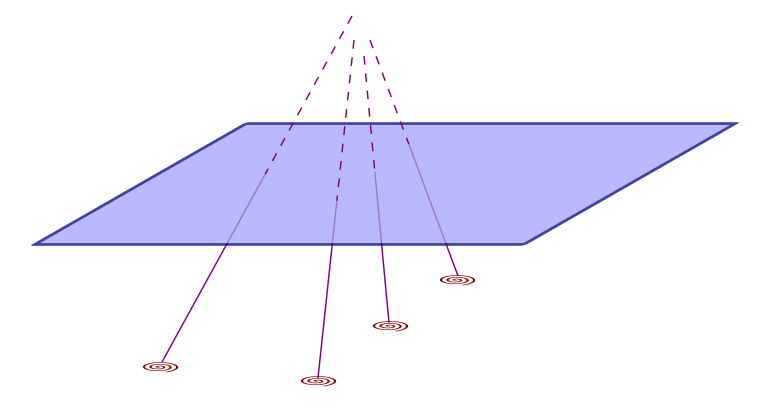
When the early Christians used to read the gospels in the right way for the time, they entered intimate co-experience of Christ's Earthly journey. The words of the gospels were anchors for the elemental moments of existence (symbolized by the spirals) that fit musically within the overarching moment of existence (the passage of Christ through the Earthly states). These souls, however, were humble enough to grasp that these words, these moments of existence, were ones of a Divine Being. They felt the 'lines of sight' passing through these words converge somewhere much higher (or in the future). The experience of Christ for these souls was to feel aligned in faith and mystical union with the lines of sight, even though they could not experience in clear consciousness the perspective nearer the convergence. They just felt that these words have a mystical center of gravity that is Truth. They felt that there's indeed such a Being, for which these elemental moments are Truthful, just like the memories of our life are truthful to our soul.
With the progress of the intellectual age, however, things were slowly taking the following course:
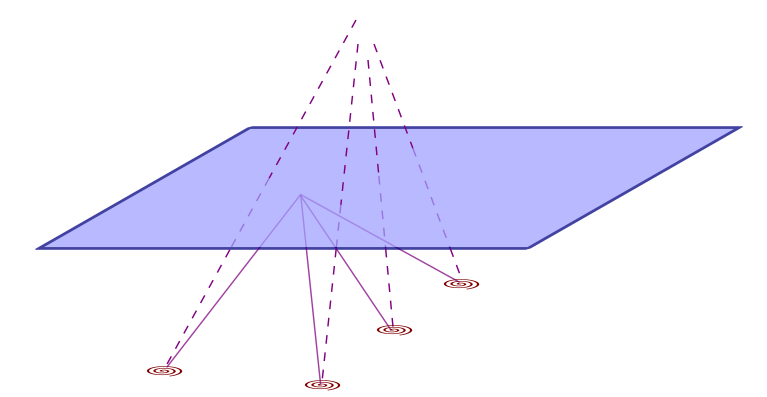
The intellectual ego was becoming more and more emancipated and self-centered. Effectively, this means that the ego positions itself at the threshold and accepts only what it can encompass in its past sensory-intellectual moments of existence. Thus the words of the Gospels were also skewed (seen from an incorrect point of convergence). One could not help but read them through such a sensory-intellectual prism. And even those who still wanted to be faithful Christians had to deal with the changing reality. When the early Christian co-experienced the turning of water into wine, they mystically felt united with a Divine act, whose origin was high in the future. When the later Christian read these words, they could only summon an image of a supernatural act – physical morphing of substances, as it must have appeared to witnessing bodily eyes. And here a conflict brewed – one could simply not witness such moments of existence in the familiar sensory world. Thus, even if they believed them, they stood in somewhat of a conflict with the world experience as we have it. To alleviate this, everything had to be considered more and more like symbols.
If such symbols are taken entirely within the ego's cone, one of two things happens: either they are considered aliases for other sensory-intellectual experiences (a kind of positivism), or they are considered as actual symbols for deeper mysteries, in which, however, the intellectual ego has no place.
The occultism of the last two millennia was secretly preparing the bridge.
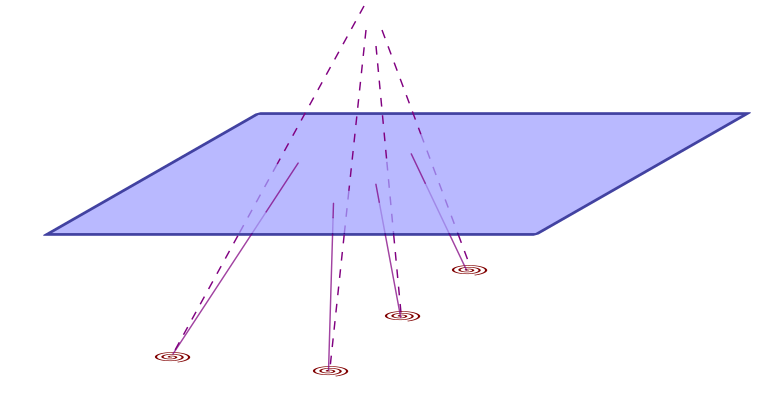
The Initiates were crossing the threshold and, in a sense, could precipitate mental images of moments of existence that made sense only from the corresponding future point of convergence (a higher self). This process was still more or less instinctive. One was fully aware that they were now active within a higher Cosmic Order of Time, yet from thence, only images could precipitate that were taken from the sensory-intellectual conceptual vocabulary (just like the words of the Gospels had to be embodied in the vocabulary of existence of the time).
The second image can be repeated here. Those who try to grasp reality as an assembly of perfectly fitting puzzle pieces can only do that within the cone of the past. This makes sense. If we are to know the perfect picture (the final ToE or MoE), its pixels must already be encompassed. Otherwise, there will always be something missing. With this predisposition, it is only natural that lines of the concepts and images projected from a future point of convergence will be skewed to fit the ego point at the threshold. They will be sought to be understood as assemblies of familiar past moments of existence, which, of course, results in caricatures.
Spiritual Science appears in the stream of evolution to lead man into the future while avoiding the trap of the closure of the ego at the threshold. It would be useless to simply preach to people to return to the old ways and read the gospels like children. The intellectual lines of sight have to find a higher, future point of convergence. To understand SS, we first need to understand that the closure of the ego is an illusory trap. Essentially, we equate ourselves to the point-at-infinity, the Absolute (unknowingly or knowingly - as in the "I am God" philosophy). The true Absolute can be pointed to through the abstract idea of the convergence point of all elemental lines of sight; all elemental moments of existence are fitting vibrations in this Absolute Chord. When we prematurely say, "I am the Absolute", we secretly imagine that all lines of sight must converge into our present sense of self. This implies that we deem ourselves fit to understand the secret of existence because all rays already converge within our vantage point. It's only a matter of removing obstructions and segregating the true from the false.
The 'open-coneness' of self-consciousness can be taken as the definition of what a being is. It's a vantage point of existence, whose lines of sight are skewed with respect to the Absolute lines, and thus, were they to be continued until their convergence, would intersect at a point that is offset from the Absolute center of convergence. It can be said that perspectives of being that disrupt the Cosmic order are those who prematurely seek to feel as the Center of Convergence of all (remaining blind about their skewed perspective).
Thus, the second thing is that it is a matter of freedom to seek harmonic alignment with the deeper points of convergence. These are perspectives of Being that are more and more closely approaching the perspective of Absolute convergence. This approach is not achieved by applying control but by opening in prayer. By willfully imploring that our every next moment of existence that we breathe in, and replaces the previous, is more aligned with the Absolute.
So, spiritual science doesn't simply discard the heartfelt warmth of the Gospels as childish, but saves the intellectual ego from its premature closure and leads it toward the point of convergence from whence the mements of existence depicted in the Gospels begin to make higher sense. Not only as mystical anticipation, but with the same intuitive clarity with which intellectual moments of existence that fit together make sense and lead us into overarching moments of being.
The same thing can be said about occultism of the age of the intellectual soul. The images, such as those you quoted above, are not to be simply discarded as obsolete or incorrect, just like we do not discard the Gospels. Yet, we must also realize that this Hermetic cognition of the last centuries was shaped in specific conditions – in the age of the intellectual soul. We cannot simply adapt the language to the modern age by polishing the words, just like we do not change much by translating the Bible, for example, in modern and thus more accessible English instead of using the forms of the more archaic King James version (this reminds me of attempts ot make the Bible more accessible to modern man by rapping it
 ). We understand the Gospels in the true sense by moving toward deeper points of convergence, not by rearranging the elemental moments of existence as they are experienced from our current point of convergence. In other words, our understanding grows not by finding the right-for-all-times concepts and mental images that build the perfect elemental chord from within our present point of convergence, but by progressively growing out of the past moments of existence (which now appear elemental) and grasping everything from within deeper points of convergence. Thus, we understand the Gospels by progressively growing out of the consciousness of the early Christians, then of the medieval thinkers, then the modern thinkers that have stripped the intellectual ego to the bone, and now we must continue further toward a point of convergence that we call the spiritual soul.
What we do here with our descriptions – including the present lines and points of convergence – is certainly not yet full-spectrum esoterism, but allows our intellect to cross the threshold almost seamlessly. In the Hermetic age, the symbols were still, well, arcane. Even the esoterist himself felt that there's a certain distance (indirectness) between the elemental moment experienced as the symbol and the living experience from whence it is projected. In proper phenomenology, however, this distance gets shorter and shorter. In a way, our intellectual movements become almost literal expressions of the higher-order dynamics. This is a double-edged sword, of course, because being so intimately close to our intellectual movements, there's also great temptation to encase the mental images in the lower cone and turn them into metaphysics. At the same time, however, if we are good-willed, there are in fact fewer ways in which what we speak of here can be misunderstood – precisely because the distance is so short.
This, however, doesn't mean that what we speak of has significance only in the close vicinity of the threshold. In fact, these concepts are of such a kind that we can enter even the Devachan with them and sustain wakefulness. In the higher Devachanic state, images dissolve; growth-like intuitive metamorphoses cease, but an idea like the contextual moments of existence, lines and convergence, can remain as holistic Intuition. No longer as a mere thought in the head, but as the 'intuitive lattice' of our being, so to speak. If in the embodied state our ego-being feels like a human form, something that speaks and gesticulates, in Devachan we are indeed a perspective of experience of the World flow, relative to the Absolute. Yes, this doesn't in itself give us consciousness of the individual nature of the highest beings, but is nevertheless a state from which we can have a foothold and grow.
Re: Anthroposophy for Dummies
Hi Kaje,Kaje977 wrote: ↑Wed Nov 04, 2026 7:44 pm Somehow the descriptions you two provided sound very abstract and impersonal, as if these beings were more like "particles". I realize that I'm misunderstanding something here (or perhaps you were referring to elemental beings in general), but there must be a reason why many occult authors often refer to these elemental beings as "gnomes", "undines", "sylphs" and so on. We find similar descriptions from other cultures as well that seem to match what we would call "undines". There are also many occult testimonies in which these realms are explored in depth, including some theosophical works such as *The Kingdom of Gods*: https://www.theosophy.world/books/geoff ... rey-hodson
Perhaps I’m misunderstanding something here, but quite many were capable of communicating with these beings (most of them adepts, not just initiates), of course "communication" meaning something entirely different than the habitual sensual-thinking mode. I don't know, but the poetic and artistical aspect seems to be missing here, or I just haven't been through the stages yet to make clear of what you both mean.
Cleric covered many of the points that came to mind for me on this question. There is no dispute that we are dealing with living beings, and we can actively work with them (which is what we always instinctively do in our scientific-technological efforts) by aligning with the higher beings that trace the elemental 'lines of sight'. The main question surrounds the most fruitful method for modern intellectual man to rediscover the inner reality of these beings and their activities. When we encounter communications pertaining to these realities, there is a simple test we can employ: does it feel like more of a finished description about 'the nature of elemental beings' that we can fit into our current intellectual understanding of reality, or more like a meditative prompt that, as Cleric put it, invites us to close the distance between our current understanding and an unfamiliar future perspective (of the higher self) that can intuitively elucidate the elemental moments of existence? Of course, the same words could be approached in both ways, depending on the recipient's interest and perspective. The spiritual scientific method, however, attempts to structure the words so they also make explicit the method by which they should be approached, leaving less room for misunderstanding and for the intellect to cram the images into its familiar intuitive slots based on its past sensory conditioning. (And we should acknowledge here that even Steiner didn't always have the best conceptual tools to reduce this indirection - as we have seen, there are plenty of cases where the communications have been approached in the former way.)
I am also curious, though, if you could elaborate on why you feel this discontinuity. For instance, you seem to grasp quite well the phenomenological method of Cleric's GL essays, feeling that they helpfully orient your imagination toward supersensible realities, and are enthusiastic to continue that exploration. Yet when a very similar method is applied to elucidating the nature of 'elemental beings', you feel it has become too abstract and impersonal, and presumably not too helpful for understanding such beings. Do you have any thoughts on why that may be, where the difference may reside?
"They only can acquire the sacred power of self-intuition, who within themselves can interpret and understand the symbol... those only, who feel in their own spirits the same instinct, which impels the chrysalis of the horned fly to leave room in the involucrum for antennae yet to come."
Re: Anthroposophy for Dummies
Hi Ashvin and ClericAshvinP wrote: ↑Thu Nov 05, 2026 3:47 pm I am also curious, though, if you could elaborate on why you feel this discontinuity. For instance, you seem to grasp quite well the phenomenological method of Cleric's GL essays, feeling that they helpfully orient your imagination toward supersensible realities, and are enthusiastic to continue that exploration. Yet when a very similar method is applied to elucidating the nature of 'elemental beings', you feel it has become too abstract and impersonal, and presumably not too helpful for understanding such beings. Do you have any thoughts on why that may be, where the difference may reside?

Yes, that's right. I suspect the discontinuity arises mainly because I haven't yet been able to establish the right relation with the descriptions you both have provided, or with the numerous descriptions from other practitioners who can "directly" encounter such elemental beings on an intuitive level. In particular, I'm also aware that Bardon offers a path of training to become an adept here, which is something different from being an initiate or a clairvoyant (Steiner describes the distinction between the three very well), so perhaps that’s part of the reason as well.
Maybe it's also a matter of time, and it simply takes time. It's probably because I haven't delved deeply enough into the material yet. I’ve also been thinking about starting over from scratch. Somehow, I don't seem to be making much progress in general recently.