Early/late Steiner

Any topics primarily focused on metaphysics can be discussed here, in a generally casual way, where conversations may take unexpected turns.
Anthony66
Posts: 257
Joined: Wed Sep 01, 2021 12:43 pm

Re: Early/late Steiner

Post by Anthony66 »

Cleric wrote: Sat Aug 22, 2026 6:14 am
Anthony66 wrote: Fri Aug 21, 2026 3:35 pm Are you able to suggest which essays are most pertinent?
Of the most recent works, I think The Game Loop: Part 6 Concentration (and subsequent parts) pinpoints what we are talking about.

In a nutshell, what you objected to previously still maintains the strictly compartmentalized sense of being - we experience a dissociated sphere of existence; the greater World process impresses at the boundary as various phenomena, while our intellectual process arranges storyboard-like mental images (of the impressions) strictly within the sphere. Seen in this way, it's not surprising that even when we investigate our own spiritual activity, we can only conceive through analogy that something similar may be happening for other dissociated spheres. And additionally, we're always haunted by the solipsistic uncertainty: what if I'm the only dissociated sphere in existence?

To overcome this dead-end situation, we need to realize that even our thinking process, which is experienced as sequencing mental images about dissociative boundaries, our and others' personal bubbles, etc., is still part of the unitary World process. We can only move forward if we clearly recognize this dual aspect: on one hand, we have the meaning implied in the fragmentary storyboard sequences (models of existence). On the other, if we are attentive, we should realize that these storyboard flashes are modulated on top of the primary flow of the World process (they are not some 'other' special process, independent of the total World flow). The question is: is there a way to know this World process in a more direct way, and not by indirect sequencing ripples on its surface? The answer comes through the method of meditative concentration, which fundamentally shifts our scientific perspective. It is enough to attempt to concentrate our attention even for a few seconds in order to get a hint of this. In a sense, it is 'inverse' knowing (although as we progress we realize that this is the natural way of knowing, while it is precisely our present intellectual knowing that is more like an 'unnatural' inverse mode). We no longer instinctively build storyboard sequences and wonder whether they faithfully mirror true reality beyond the dissociative boundary, but we come to know something of the World process through the fact that it pushes our attentive stream into various directions. IOW, initially we come to know something of the World process not by picturing what it is, but by observing how our intended concentrated flow is pressured (thus the 'inverse' nature of knowing). There's a special quality of realness to this experience. We simply cannot deny it. If it were an illusion we could simply 'walk through it'. And this is an especially tricky part. We may say, "I can sustain my concentration if I wanted to. But I just don't feel like it right now; I have other things to do." It is precisely this 'wanting to attend to the other things' that is already an inverse intuition for how the World process pressures us. As long as we believe that this tendency (to attend to the other things) is our pure and free will, independent of the World process, we have no chance of knowing reality.

We can doubt our abstract metaphysical mental images about what these pressures are, but not that the pressures are real. So in a very general sense, this path of knowledge begins by resisting through concentration the usual pushes and pulls of our inner life, which are aspects of the World process (including our tendency to attend to other 'more important' things). This is not yet the experience of other agencies. We get to know about the latter when the meditative path goes even further and we gradually realize that the pushes and pulls of our inner life proceed from meaningful activity.

So in a nutshell: it is easy to conceive that the World process impresses at the dissociative boundary as sense impressions. Meditative concentration can be thought of as moving this boundary closer to our core intuitive process, such that even our thinking flows feel shaped and constrained by the impress of the World process. Now even our opinions, preferences, sympathies and antipathies feel like pressures that compete to rule our inner movie flow. And the critical thing to realize is that we no longer have the inner leeway of the personal sphere to philosophize about these impressions because now the very philosophical thoughts feel shaped and constrained by the impress. IOW, now even our personal intellectual flow is grasped as an interplay between deep intuitive steering and the friction with the World process (for example, what we consider to pertain to the nervous system).
I re-read your essays and very much enjoyed them. They present a disciplined phenomenology explicitly refusing mechanistic explanations. The closing re-conception of intelligence as following the gradient of "makes sense" - steering toward musical coherence rather than executing complex calculation - is, as a phenomenology of what thinking feels like from inside, is very good.

But if I'm understanding you, "makes sense" becomes a truth-tracking faculty: following the gradient of meaningfulness is a way of knowing reality, an alternative to prediction-and-test that puts us in contact with "the momentary curvature of the flow" as it actually is. This is no longer a claim about how thinking feels. It's a claim that the felt-coherence gradient tracks something real in the world. But the Everest-in-fog image shows, and I think you acknowledge this, that gaining altitude (feeling-good, feeling-coherent) doesn't guarantee approaching the true peak, that you may be climbing a local hill. From the inside, the local hill and the true summit feel identical - both are "up," both "make sense," and in the fog you cannot tell which you're on. You seem to see this as a relative difficulty ("This rarely happens through a monotonic increase. It is an iterative process.") rather than a structural impossibility of using felt-coherence to certify truth. What would tell the summit from the hill is precisely an external altimeter - some check outside the felt gradient. In the fog, without instruments, "keep going up" cannot distinguish them. But you refuse the altimeter - that would be "picture-in-picture modeling", the enemy.

In the immediate post here you summarize things - there are pushes and pulls on our inner life by the World process. But this is pretty obvious - we get distracted and it's difficult to stay focused. It all comes down to whether we can establish that the pushes and pulls are other agencies or utterly impersonal - the friction of a mechanism, the inertia of habit, or the statistics of a distractible brain. It sounds like your next essay(s) are going to answer this!

User avatar
Rodriel Gabrez
Posts: 119
Joined: Tue Aug 12, 2025 4:11 pm

Re: Early/late Steiner

Post by Rodriel Gabrez »

I wonder whether the whole problem of verification is, in a sense, orthogonal to the purpose of Steiner's spiritual-scientific output. It may arise because we are interpreting the contents of spiritual science primarily as facts and thereby importing the epistemological requirements appropriate to one mode of cognition into another.

"Fact" may simply be the linguistic cloak that modern consciousness is compelled to use in order to communicate what is actually closer to an enzyme. Steiner has to say things in forms like "X happened," "Y existed," or "Z is the activity of such-and-such a Being," because our language is overwhelmingly adapted to representing objects, events, and causal relations. But it does not follow that the primary purpose of these statements is to populate an otherwise familiar world-picture with additional, supersensible objects and events.

I like to view the "facts" of spiritual science as icons of activity. They are conceptual-imaginative precipitations of impulses and streams which cannot appear within ordinary intellectual consciousness in their native form. Their primary value therefore lies not in our possessing the correct representation, but in what happens when the representation is actively taken up into thinking. In that sense they are, again, more like enzymes than pieces of information: they are meant to catalyze an activity.

If so, asking how such a content can be "verified" may sometimes involve an analogous category error to what we find in the "hard problem of consciousness." The problem is generated in part by the conceptual architecture we bring to it. We first imagine spiritual cognition as perception of a hidden world of quasi-objects, analogous to sensory objects, and then naturally ask why independently trained clairvoyants cannot inspect those objects and converge upon the same descriptions. But perhaps this already spatializes and objectifies precisely what spiritual cognition is attempting to approach differently.

This does not, however, mean that anything Steiner says can be protected from criticism by declaring it "spiritual" whenever difficulties arise. We have to distinguish epistemic registers, although even these registers cannot simply be treated as timelessly self-identical.

To whatever extent a spiritual-scientific statement enters the sensory-empirical register, it becomes accountable to what can actually be encountered there. If a treatment is claimed to produce a measurable physiological effect under present conditions, then present empirical methods are entirely appropriate for investigating that effect. Logical claims remain logically accountable, and claims concerning presently observable phenomena cannot be insulated from observation by appealing to their esoteric origin.

As has been pointed out here, the situation becomes considerably more complicated, however, when present empirical methods are used not merely to investigate present phenomena but to reconstruct remote phases of terrestrial or cosmic evolution. Here measurement and extrapolation have to be distinguished. A method may establish a relation with extraordinary reliability under presently given lawful conditions while its projection into another cosmic epoch presupposes that the relevant lawful conditions themselves have remained sufficiently invariant.

But, as has also been mentioned, this invariance is precisely one of the things spiritual science may call into question. If cosmic evolution includes transformations not merely of the contents appearing within nature but of the lawful conditions under which nature manifests at all, then present measurements cannot simply be projected backward indefinitely without remainder. The resulting reconstruction is not "mere observation"; it includes assumptions about the continuity of the very framework within which observation presently becomes intelligible.

This cannot become an escape hatch whereby every conflict with empirical evidence is explained away by saying that "the laws were different then." That would simply make spiritual science immune to correction. Rather, it means that the conflict itself has to be located carefully. We should ask whether an empirical finding directly contradicts something spiritual science claims should be observable under the same conditions, or whether the contradiction appears only after the empirical finding has been embedded within a reconstruction that presupposes continuity of conditions across qualitatively different epochs.

In the first case, spiritual science should simply bear the contradiction. In the second, however, the disagreement may concern something deeper than competing factual claims: it may concern whether the lawful structure disclosed by present cognition can legitimately be treated as the invariant measure of every phase of cosmic unfolding.

This is especially important because the epistemic registers themselves may be products of the differentiation being described. It's likely a mistake to imagine a timeless box called "empirical reality," another called "spiritual reality," another called "logic," and then simply sort Steiner's statements among them. The empirical register is real and binding within the conditions under which it operates. What is questionable is its elevation into an invariant ontological grammar for reality as such.

Indeed, some of Steiner's strangest cosmological pictures may have precisely the function of preventing this unconscious backward projection. A condition such as Old Saturn, for example, becomes almost nonsensical if imagined merely as a fantastically ancient physical environment governed by the categories through which present natural science organizes matter, force, organism, consciousness, space, and time. But perhaps the point of the picture is precisely to make thinking capable of approaching conditions in which these categories have not yet differentiated in their present form. Spiritual-scientific cosmology would then concern, among other things, the genesis of the very categories through which we presently construct an empirical account of cosmic history.

The spiritual content is therefore not necessarily exhausted by whatever proposition precipitates into one of our present epistemic registers. The same statement may carry an empirical implication while simultaneously functioning as an imaginative expression of an activity that cannot be reduced to that implication. A failure in one register genuinely matters within that register, but it does not automatically settle the nature or value of the originating spiritual content.

The spiritual-scientific content as spiritual-scientific content would consequently require another kind of evaluation. Not simply, "Does this sentence correspond to a hidden object in the way that an empirical proposition corresponds to a sensory state of affairs?" but something more like: What does this content do to cognition when it is actually metabolized? Does it disclose relationships that were previously unavailable? Does it make thinking increasingly capable of following processes rather than merely arranging representations? Does it illuminate otherwise disconnected phenomena without proliferating ad hoc explanations? Most importantly, does it eventually liberate the student from dependence upon the representation itself by awakening the activity of which the representation was only a carrier?

This is where morality and the person-as-instrument intersects the epistemological domain. The two, as Steiner often reminds us, are inseparable. I'd hesitate, though, to make moral purification itself a criterion of verification. Different spiritual traditions can cultivate profound moral development while articulating apparently incompatible accounts of reality. Moral development may be epistemologically indispensable insofar as the cognitive instrument is the person himself—it may reduce the distortions introduced by desire, vanity, fear, antipathy, attachment, etc.—but it cannot by itself establish the truth of a particular spiritual-scientific proposition.

Nor, from this perspective, do the differing spiritual traditions necessarily need to be conceived simply as competing inventories of claims about the same static supersensible geography. Their apparently incompatible pictures may themselves function within different streams, historical conditions, and transformations of consciousness. That possibility does not magically reconcile their contradictions, but it changes the nature of what would have to be compared. One would need to understand not merely what each picture says, but what cognitive activity it embodies, what it makes possible, and what relation that activity bears to the development of consciousness.

So perhaps the underlying misstep is to assume that spiritual science must eventually supply the modern soul (Consciousness Soul) with a new collection of sufficiently well-verified facts. It may instead be trying to transform the activity of knowing out of which our very notion of a fact arises, while leaving factual cognition completely legitimate within its proper conditions.

On this reading, the point is not ultimately to believe Steiner's pictures. Indeed, their successful use might involve their eventually becoming dispensable (a point I made a while ago, from another angle, in the Tomberg thread). There's something paradoxical about treating the contents of spiritual science as doctrines to be preserved intact in memory and defended propositionally if their intended function is to catalyze the development of a cognition capable of no longer needing them in that form. The picture has done its work when the activity it was carrying has become one's own.

This is why I'm not sure the verification problem, as presently formulated, ever quite reaches the heart of the matter. It asks whether the pictures Steiner gives us constitute reliable representations of supersensible reality. But I'd say the more fundamental question is whether they can cease being merely representations at all—whether, when properly worked with, they can become channels through which the activity they iconically express begins to participate in the inflowing and informing of our own thinking.

If that is the case, then the ultimate criterion appropriate to spiritual science would not simply be whether one has accumulated a set of correct propositions about an invisible world, but whether the supposedly spiritual "facts" have actually become active within cognition—whether the enzyme has catalyzed anything. And at that point the question is no longer simply what one knows about spiritual reality, but what one's knowing has become capable of doing.
User avatar
Cleric
Posts: 2037
Joined: Thu Jan 14, 2021 9:40 pm

Re: Early/late Steiner

Post by Cleric »

Anthony66 wrote: Thu Aug 27, 2026 3:03 pm I re-read your essays and very much enjoyed them. They present a disciplined phenomenology explicitly refusing mechanistic explanations. The closing re-conception of intelligence as following the gradient of "makes sense" - steering toward musical coherence rather than executing complex calculation - is, as a phenomenology of what thinking feels like from inside, is very good.

But if I'm understanding you, "makes sense" becomes a truth-tracking faculty: following the gradient of meaningfulness is a way of knowing reality, an alternative to prediction-and-test that puts us in contact with "the momentary curvature of the flow" as it actually is. This is no longer a claim about how thinking feels. It's a claim that the felt-coherence gradient tracks something real in the world. But the Everest-in-fog image shows, and I think you acknowledge this, that gaining altitude (feeling-good, feeling-coherent) doesn't guarantee approaching the true peak, that you may be climbing a local hill. From the inside, the local hill and the true summit feel identical - both are "up," both "make sense," and in the fog you cannot tell which you're on. You seem to see this as a relative difficulty ("This rarely happens through a monotonic increase. It is an iterative process.") rather than a structural impossibility of using felt-coherence to certify truth. What would tell the summit from the hill is precisely an external altimeter - some check outside the felt gradient. In the fog, without instruments, "keep going up" cannot distinguish them. But you refuse the altimeter - that would be "picture-in-picture modeling", the enemy.

In the immediate post here you summarize things - there are pushes and pulls on our inner life by the World process. But this is pretty obvious - we get distracted and it's difficult to stay focused. It all comes down to whether we can establish that the pushes and pulls are other agencies or utterly impersonal - the friction of a mechanism, the inertia of habit, or the statistics of a distractible brain. It sounds like your next essay(s) are going to answer this!
This is getting closer and closer to the core. Yet, there’s still this sense of a geometric boundary – of an inside and an outside. We concentrate and become increasingly sensitive to the nudges of the World flow, yet it still feels like something impinging on the wall of our phenomenal sphere from the opaque side, and becoming known as conscious phenomena on the inside.

The key realization that we need here is that when we strive toward the direction of ‘makes sense’, we do not simply drive a personal mirroring aspect of the World flow toward greater sameness with the likewise personally experienced impressions of the opaque Flow (yet always remaining on two irreconcilably opposite sides of the World coin). Our thinking process is surely an aspect of the unitary World process (even according to physicalism). As such, seeking to push the World state toward greater intuitive coherency is no longer merely a matter of personal-bubble knowledge, but is the driving force of the evolution of the World state – at least some quite limited aspect of it (presently). This is the key moment that allows us to move further. The realization that in our inner process we not only know but we participate in the World unfolding. Normally, we feel a kind of separation. In our mind we only think and know; with our will we act in the outer world. Yet, even in materialism we can see that thinking is associated with transformations of the World state (the brain). So, there's will also in thinking; when we think, we already nudge the unfolding of the World state.

This is completely in line with what Rodriel very well explained above. Knowledge becomes something practical. Knowledge and life skills coincide. To know is to be in a position to push the World state in novel meaningful directions. Of course, I’m not speaking about immediately jumping to change the wide world according to our intents, but about first finding ways to steer our inner life.

Such steering consists also of overcoming secret thinking attractors which snap our mental process into one or another channel, and we fail to realize that there could be other ways. One such attractor that secretly formats our thinking is the geometric grasp of inner experience – namely, the idea of a boundary between our inner world and the opaque aspects of the World flow (for which we wonder whether they are agentic – tracking the gradient of meaning – or mechanical – tracking some lifeless principle of least action). A metaphor less prone to confusion could be if we imagine that there’s only one side of phenomenal experience. In that case, it’s like all conceivable perspectives of experience are superimposed, sharing a common center, but differ in ‘frequencies’. A perspective is not something that an external entity attunes to, but rather a coherent sense of the total World flow that feels like integrating a unique memory continuum. In a way, even now, every other possible first-person World states can be considered to be superimposed with ours, yet only those stand out which integrate into a coherent memory continuum.

I know this sounds very abstract, but it is nevertheless a direction of thinking that leads to inner liberation. It is not ‘the truth’. As Rodriel says, these are still only icons. Yet we need to sense when given icons, even if appropriate at a given time, become obstacles later. Such is the picture of the dissociative boundary.

It’s like this:

- In the physical (objective) consciousness, we feel that a person speaks from ‘over there’, from within their physical avatar. We feel centered within our sphere of sensory phenomena and the rest of the World is on the opaque side.

- In Imagination, we still feel as if contemplating an inner sphere of individual consciousness, yet we no longer feel that there’s something on the opaque side. Indeed, there’s no boundary. This phenomenal sphere extends like hyperbolic space into infinity. There’s no such place where our sphere ends and there’s another on the opaque side (such an idea only grows from within our physical intuition, where phenomenal space feels filtered down to the innerly experienced shape of a human body; that is, we feel a volume of sensations within the skin and 'blotted out' outside). The metamorphoses of this phenomenal space now feel as impressions of inner activity, just like we feel that our activity contributes something to the trajectory of metamorphosis. We feel that we are intermingled with these activities, yet we do not yet feel them as proceeding from coherent agencies.

- In Inspiration, we begin to grasp that certain metamorphoses of the phenomenal World space follow the intents of coherent inner life – of various operational, tactical, and strategic intents. Here’s the critical part. We do not simply infer that inner life from the way the phenomenal space ripples, in the exact same way we do not infer our ordinary intuitive life (thinking) from the way our inner words sound. We distinguish the sounds of our inner voice from any other sensory or mental sounds by the fact that we feel creatively in phase with it. In the same way, in Inspiration our consciousness expands and experiences certain aspects of phenomenal World space metamorphosis as being in phase with Cosmic intents. We know them not by inferring them and making an intellectual model woven of our own mental words, but by our own mental voice transforming such that we are now of the same ‘wavelength’ as the activity that pushes the World state at these scales.

- In Intuition, these Cosmic intents can be followed to their ‘barycenters’ of integrating memory. In other words, we not only feel phenomenal World space metamorphosing according to criss-crossing Cosmic intents, but the latter make the fullest sense when they are seen as proceeding from centers of integrating existential stories, just like our inner life makes the fullest sense for another being when they can assume the viewpoint of our ego.


I hope this also throws light on your question about the gradient tracking in the fog. Intuition reveals that, ultimately, there’s only spiritual activity. All more manifested states of being can be thought of as this primal intuition being diminished, thus experiencing in a coherent manner only a small aperture of the phenomenal spectrum, while all those Cosmic intents, become obscured and feel like the interference of an outer world, as the ripples in a pool that all proceed from coherent centers, yet after numerous reflections feel like a chaos of waves for a perspective that is unaligned with the origins.

Your question about the gradient in the fog implies that we are ‘on our own’ when tracking the curvature of these chaotic interferences. We can only myopically glide through the momentary curvature of becoming and form our inner-bubble representational intuition (map) of the greater picture. However, if we take the nature of higher cognition seriously, we realize that our intuitive pushing is ‘on the same side’ as the Cosmic intuitive pushing. “I in them, and thou in me, that they may be made perfect in one”. In practical terms, all of this leads us into a far deeper and scientific understanding of prayer. Not in the naive sense of asking speculative deities for favors and things, but precisely as the opening of our soul in readiness to align with the higher Cosmic intents; to feel, even if momentarily, how our inner voice is a constrained manifestation of the Cosmic Word, and knowing World creation means to expand to the ‘wavelengths’ of Cosmic intents that push the metamorphoses of World space at different scales. It is by seeking resonance with these intended curvatures of becoming that we have the compass, or the altimeter, that tells us where the World flow is intended and whether we are pushing our limited aperture in a direction aligned with these greater curvatures of Cosmic evolution.

The way we conceive this expansion of phenomenal space can also be an obstacle, just like picturing the boundary. Naively, we would imagine that the expansion leads to a purely geometric widening such that we begin to feel in our inner space also the chairs, the tables, and so on. However, this would be highly misleading. We are on a more correct track if we conceive of the gradual expansion of inner life. In other words, at the higher levels we have the potential for what the first-person experience of becoming could be in general lines. Lesser forms are like filtration or concretization of the potential, while the filtered potential now becomes a periphery (thus multiplicity). There're so many more things to be said here if this in itself is not to become misleading, but at least it points in a more fruitful direction.
Image
Anthony66
Posts: 257
Joined: Wed Sep 01, 2021 12:43 pm

Re: Early/late Steiner

Post by Anthony66 »

Cleric wrote: Fri Aug 28, 2026 7:32 pm
Anthony66 wrote: Thu Aug 27, 2026 3:03 pm I re-read your essays and very much enjoyed them. They present a disciplined phenomenology explicitly refusing mechanistic explanations. The closing re-conception of intelligence as following the gradient of "makes sense" - steering toward musical coherence rather than executing complex calculation - is, as a phenomenology of what thinking feels like from inside, is very good.

But if I'm understanding you, "makes sense" becomes a truth-tracking faculty: following the gradient of meaningfulness is a way of knowing reality, an alternative to prediction-and-test that puts us in contact with "the momentary curvature of the flow" as it actually is. This is no longer a claim about how thinking feels. It's a claim that the felt-coherence gradient tracks something real in the world. But the Everest-in-fog image shows, and I think you acknowledge this, that gaining altitude (feeling-good, feeling-coherent) doesn't guarantee approaching the true peak, that you may be climbing a local hill. From the inside, the local hill and the true summit feel identical - both are "up," both "make sense," and in the fog you cannot tell which you're on. You seem to see this as a relative difficulty ("This rarely happens through a monotonic increase. It is an iterative process.") rather than a structural impossibility of using felt-coherence to certify truth. What would tell the summit from the hill is precisely an external altimeter - some check outside the felt gradient. In the fog, without instruments, "keep going up" cannot distinguish them. But you refuse the altimeter - that would be "picture-in-picture modeling", the enemy.

In the immediate post here you summarize things - there are pushes and pulls on our inner life by the World process. But this is pretty obvious - we get distracted and it's difficult to stay focused. It all comes down to whether we can establish that the pushes and pulls are other agencies or utterly impersonal - the friction of a mechanism, the inertia of habit, or the statistics of a distractible brain. It sounds like your next essay(s) are going to answer this!

This is getting closer and closer to the core. Yet, there’s still this sense of a geometric boundary – of an inside and an outside. We concentrate and become increasingly sensitive to the nudges of the World flow, yet it still feels like something impinging on the wall of our phenomenal sphere from the opaque side, and becoming known as conscious phenomena on the inside.

The key realization that we need here is that when we strive toward the direction of ‘makes sense’, we do not simply drive a personal mirroring aspect of the World flow toward greater sameness with the likewise personally experienced impressions of the opaque Flow (yet always remaining on two irreconcilably opposite sides of the World coin). Our thinking process is surely an aspect of the unitary World process (even according to physicalism). As such, seeking to push the World state toward greater intuitive coherency is no longer merely a matter of personal-bubble knowledge, but is the driving force of the evolution of the World state – at least some quite limited aspect of it (presently). This is the key moment that allows us to move further. The realization that in our inner process we not only know but we participate in the World unfolding. Normally, we feel a kind of separation. In our mind we only think and know; with our will we act in the outer world. Yet, even in materialism we can see that thinking is associated with transformations of the World state (the brain). So, there's will also in thinking; when we think, we already nudge the unfolding of the World state.

This is completely in line with what Rodriel very well explained above. Knowledge becomes something practical. Knowledge and life skills coincide. To know is to be in a position to push the World state in novel meaningful directions. Of course, I’m not speaking about immediately jumping to change the wide world according to our intents, but about first finding ways to steer our inner life.

Such steering consists also of overcoming secret thinking attractors which snap our mental process into one or another channel, and we fail to realize that there could be other ways. One such attractor that secretly formats our thinking is the geometric grasp of inner experience – namely, the idea of a boundary between our inner world and the opaque aspects of the World flow (for which we wonder whether they are agentic – tracking the gradient of meaning – or mechanical – tracking some lifeless principle of least action). A metaphor less prone to confusion could be if we imagine that there’s only one side of phenomenal experience. In that case, it’s like all conceivable perspectives of experience are superimposed, sharing a common center, but differ in ‘frequencies’. A perspective is not something that an external entity attunes to, but rather a coherent sense of the total World flow that feels like integrating a unique memory continuum. In a way, even now, every other possible first-person World states can be considered to be superimposed with ours, yet only those stand out which integrate into a coherent memory continuum.

I know this sounds very abstract, but it is nevertheless a direction of thinking that leads to inner liberation. It is not ‘the truth’. As Rodriel says, these are still only icons. Yet we need to sense when given icons, even if appropriate at a given time, become obstacles later. Such is the picture of the dissociative boundary.

It’s like this:

- In the physical (objective) consciousness, we feel that a person speaks from ‘over there’, from within their physical avatar. We feel centered within our sphere of sensory phenomena and the rest of the World is on the opaque side.

- In Imagination, we still feel as if contemplating an inner sphere of individual consciousness, yet we no longer feel that there’s something on the opaque side. Indeed, there’s no boundary. This phenomenal sphere extends like hyperbolic space into infinity. There’s no such place where our sphere ends and there’s another on the opaque side (such an idea only grows from within our physical intuition, where phenomenal space feels filtered down to the innerly experienced shape of a human body; that is, we feel a volume of sensations within the skin and 'blotted out' outside). The metamorphoses of this phenomenal space now feel as impressions of inner activity, just like we feel that our activity contributes something to the trajectory of metamorphosis. We feel that we are intermingled with these activities, yet we do not yet feel them as proceeding from coherent agencies.

- In Inspiration, we begin to grasp that certain metamorphoses of the phenomenal World space follow the intents of coherent inner life – of various operational, tactical, and strategic intents. Here’s the critical part. We do not simply infer that inner life from the way the phenomenal space ripples, in the exact same way we do not infer our ordinary intuitive life (thinking) from the way our inner words sound. We distinguish the sounds of our inner voice from any other sensory or mental sounds by the fact that we feel creatively in phase with it. In the same way, in Inspiration our consciousness expands and experiences certain aspects of phenomenal World space metamorphosis as being in phase with Cosmic intents. We know them not by inferring them and making an intellectual model woven of our own mental words, but by our own mental voice transforming such that we are now of the same ‘wavelength’ as the activity that pushes the World state at these scales.

- In Intuition, these Cosmic intents can be followed to their ‘barycenters’ of integrating memory. In other words, we not only feel phenomenal World space metamorphosing according to criss-crossing Cosmic intents, but the latter make the fullest sense when they are seen as proceeding from centers of integrating existential stories, just like our inner life makes the fullest sense for another being when they can assume the viewpoint of our ego.


I hope this also throws light on your question about the gradient tracking in the fog. Intuition reveals that, ultimately, there’s only spiritual activity. All more manifested states of being can be thought of as this primal intuition being diminished, thus experiencing in a coherent manner only a small aperture of the phenomenal spectrum, while all those Cosmic intents, become obscured and feel like the interference of an outer world, as the ripples in a pool that all proceed from coherent centers, yet after numerous reflections feel like a chaos of waves for a perspective that is unaligned with the origins.

Your question about the gradient in the fog implies that we are ‘on our own’ when tracking the curvature of these chaotic interferences. We can only myopically glide through the momentary curvature of becoming and form our inner-bubble representational intuition (map) of the greater picture. However, if we take the nature of higher cognition seriously, we realize that our intuitive pushing is ‘on the same side’ as the Cosmic intuitive pushing. “I in them, and thou in me, that they may be made perfect in one”. In practical terms, all of this leads us into a far deeper and scientific understanding of prayer. Not in the naive sense of asking speculative deities for favors and things, but precisely as the opening of our soul in readiness to align with the higher Cosmic intents; to feel, even if momentarily, how our inner voice is a constrained manifestation of the Cosmic Word, and knowing World creation means to expand to the ‘wavelengths’ of Cosmic intents that push the metamorphoses of World space at different scales. It is by seeking resonance with these intended curvatures of becoming that we have the compass, or the altimeter, that tells us where the World flow is intended and whether we are pushing our limited aperture in a direction aligned with these greater curvatures of Cosmic evolution.

The way we conceive this expansion of phenomenal space can also be an obstacle, just like picturing the boundary. Naively, we would imagine that the expansion leads to a purely geometric widening such that we begin to feel in our inner space also the chairs, the tables, and so on. However, this would be highly misleading. We are on a more correct track if we conceive of the gradual expansion of inner life. In other words, at the higher levels we have the potential for what the first-person experience of becoming could be in general lines. Lesser forms are like filtration or concretization of the potential, while the filtered potential now becomes a periphery (thus multiplicity). There're so many more things to be said here if this in itself is not to become misleading, but at least it points in a more fruitful direction.
Image
Your description of Imagination → Inspiration → Intuition as a dissolution of the inside/outside boundary is very helpful. In Inspiration we don't infer Cosmic intents from the ripples of phenomenal space (that would be the fallible modeling), rather we know them the way we know our own inner voice, by our mental voice transforming such that we are of the same wavelength as the activity. As such we have knowledge-of-Cosmic-intents on the non-inferential, in-phase side of the line as self-knowledge.There's no representation standing between knower and known.

And you name the altimeter - resonance with the intended curvature. But I have to ask, can this ever read "down"? Can "resonance with Cosmic intent" ever read false? Can you seek alignment, feel resonance, and be wrong - feel in-phase with a Cosmic intent that isn't there, or misidentify the wavelength? What if I seek alignment and fail? Is that the altimeter telling me there are no Cosmic intents or is it a faulty altimeter?

The claim is that inner-voice knowledge is incorrigible because it's non-inferential - you can't misperceive your own inner voice, there's no gap. But that incorrigibility is exactly what makes it useless as an altimeter, because an altimeter must be corrigible - it must be the kind of thing that can contradict you. Self-knowledge of your inner voice doesn't seem like it can tell you you've climbed the wrong mountain.
User avatar
Cleric
Posts: 2037
Joined: Thu Jan 14, 2021 9:40 pm

Re: Early/late Steiner

Post by Cleric »

Anthony66 wrote: Sat Aug 29, 2026 2:01 pm Your description of Imagination → Inspiration → Intuition as a dissolution of the inside/outside boundary is very helpful. In Inspiration we don't infer Cosmic intents from the ripples of phenomenal space (that would be the fallible modeling), rather we know them the way we know our own inner voice, by our mental voice transforming such that we are of the same wavelength as the activity. As such we have knowledge-of-Cosmic-intents on the non-inferential, in-phase side of the line as self-knowledge.There's no representation standing between knower and known.

And you name the altimeter - resonance with the intended curvature. But I have to ask, can this ever read "down"? Can "resonance with Cosmic intent" ever read false? Can you seek alignment, feel resonance, and be wrong - feel in-phase with a Cosmic intent that isn't there, or misidentify the wavelength? What if I seek alignment and fail? Is that the altimeter telling me there are no Cosmic intents or is it a faulty altimeter?

The claim is that inner-voice knowledge is incorrigible because it's non-inferential - you can't misperceive your own inner voice, there's no gap. But that incorrigibility is exactly what makes it useless as an altimeter, because an altimeter must be corrigible - it must be the kind of thing that can contradict you. Self-knowledge of your inner voice doesn't seem like it can tell you you've climbed the wrong mountain.
Yes, errors are possible, and even inevitable, and a substantial part of the science deals with understanding their sources, just as in ordinary science we have instrumental errors, methodological errors, and so on. Getting into the details would take a whole book, and Stainer has spoken a lot about these topics. Here are just a few basic things.

First, we need to be aware that the activity of a higher-order perspective of being cannot map 1:1 to an intellectual concept. Indeed, existence in the intellectual flow can be considered as a higher-order, more coherent first-person flow that has been broken down (decohered) into imaginative shards. I have mentioned this before, but I'll remind again of Andersen's Snow Queen.
AI Summary of "The Snow Queen" wrote:A wicked demon creates a magic mirror that distorts everything good into something ugly. One day the mirror shatters, and its splinters scatter across the world. When a shard enters Kay’s eye, it makes him see only the bad in everything; when another enters his heart, it turns him cold and cruel.

Kay is eventually taken away by the Snow Queen to her palace of ice. There he sits frozen, trying to solve an impossible puzzle: arranging pieces of ice to spell the word “eternity.” The shard in his heart makes it impossible for him to succeed.

Meanwhile, his friend Gerda travels across the world to find him, meeting helpers and obstacles along the way. When she finally reaches the Snow Queen’s palace, her warm tears fall onto Kay, melting the ice in his heart and washing out the shard. Kay’s own tears then clear the shard from his eye. Freed from the spell, he can finally complete the puzzle.

Gerda and Kay return home together, older in years but still children at heart.
So in this sense, while we are stroboscopically tracking sequences of bodily and sensory phenomena (and our intellect ultimately reproduces such sequences in mental and memory images - the picture-in-picture flow), and we try to solve the puzzle of eternity by arranging such images in various combinations, we always fail. There's something in our heart and mind that keeps us locked at the frequency and rhythm of these sequences, and in a dream-like daze we keep fighting, hoping that the perfect arrangement of shards is just around the corner, the mirror will become perfect, and we'll finally see the Truth in its objective nature. This in itself is the first source of difficulties, of which Rodriel also speaks. When we crystallize the higher experiences into concepts, we inevitably lose something, just like we lose something if we try to approximate a circle with a rectangle (of course, it's more complicated than that because we speak not only of spatial forms but of existential flows).

So when we intuit the higher Cosmic dynamics, they are practically sieved through our conceptual and gestural palette - that's also why the term Inspiration is very apt. When an artist is inspired, they still need to have laid down preparatory work; a poet needs rich vocabulary, the painter needs the needed skills to linearize a holistic image into a sequence of brush strokes, and so on. As a matter of fact, each one of us lives every night within these Cosmic currents, and the reason we feel that we have spent the night in dark unconsciousness (except when dreaming) is that we haven't yet developed the intuitive cascade which allows us to resonate and 'step down' higher intuitions down into partial concepts and mental images. Expanding our conceptual and gestural palette should be a never-ending process in our Earthly life.

There are a ton more things to say. Yet, in both ordinary and spiritual science, there's no need to fear the error. What we need is an attitude, a high ideal to always strive for the Truth. We always need to seek the ever-expanding harmony of the facts and readily correct anything that stands in the way. A fear is very common: "But what if I spent my whole life studying this system of ideas and in the end it turns out that it has nothing to do with reality? I need some kind of certainty that I'm not wasting my time." Such fears exist only as long as we stay enclosed in a sphere of abstract, floating mental images. It feels that by keeping studying, we only accumulate more and more of these images, they weigh us down, but they ultimately feel only as that - mental images. It feels that - poof - and they may collapse down like a house of cards. Yet, spiritual science doesn't aim to simply give us a pile of shattered ice that we can never assemble. It shows the path of melting the ice - from the mind, through the heart, into the soul and spirit. These are stages of awakening. After each such stage, something shifts in our sense of what reality is and what we are (higher lucidity). Then, a large part of the mental images of SS come to feel as something that we can produce from our own experience. They no longer feel as volatile mental images that we shakily keep in place and call 'the truth', but we can produce them ourselves by simply putting into words what our existence feels like. The only way these descriptions can become uncertain is if we submerge back into the dream-like daze and continue grunting against the storm of shards. Of course, such highs and lows are completely normal in the course of our development. In some meditations, we reach clarity and even rapture. Then we're swayed by the trivialities of everyday life, we're back in the daze, and we even begin to doubt: "Maybe I was mistaken. Maybe I just 'imagined' that higher state." Yet, through iterations, the new consciousness becomes more and more stable and permanent.

There are always things still unverifiable for our personal abilities. Yet, as said before, certain fundamental truths are much easier to experience in their reality than more specific facts about activities of certain beings. Such truths are the Imagination -> Inspiration -> Intuition gradient that you already have a certain grasp of. The more we try to feel in our meditations the nature of these states, the more we begin to find the depth axis of reality. Then, for example, we find a way to understand our relation with the Christ in a way that is far more satisfying for our intellect. Our intellect no longer feels isolated and just accepting that some things can only be subject to faith. Yes, the intellect must reach the conviction that we can never reconstruct the mirror of eternity by finding the perfect sequence of mental jerks, but at the same time it assumes the noble role of grasping and stepping down higher intuitive dynamics through Inspiration. For example, returning to your question about the fog, it can be said that our conscience is already a kind of more encompassing intuitive sense for the steepness of becoming. Myopically, it may 'make sense' to indulge in a certain pleasurable activity, while it's as if a deeper part of our being lives together with the activity of other beings who shape the greater curvature. It is as if this part whispers to our intellect, "You are heading toward a local maximum (the momentary pleasure), followed by a chasm (the unforeseen consequences of our indulgence). You are on the wrong way (or at least not optimal)." With such a grasp of things, even our relations with the Christ can become scientific, without this in any way reducing them to abstraction. In our prayer we can invite the Christ - the common carrier stream of humanity's destiny evolving toward its Divine nature - to be our Inspirer, such that our conscience can be his direct continuation. This is far more than a simple religious metaphor. It's a real path along the depth axis, along which we begin to grasp the higher-order curvature of the existential flow. We indeed begin to awaken along the depth of lucidity, into true reality. But, as said, this also requires expanding our conceptual and gestural palette.

These are things we can experiment with. We're seeking excuses if we insist that everything must be proven and cleared of contradictions in our ordinary bodily consciousness (and we already see that this is an existential impossibility for Kay - the fallen human being). Even if finding our true inner relations with the ascending Spirit of humanity is the only thing that we take in, and remain ambivalent about other details (like Atlantis, etc.), this is already a lot more than anything we can ever reach in other ways.
Anthony66
Posts: 257
Joined: Wed Sep 01, 2021 12:43 pm

Re: Early/late Steiner

Post by Anthony66 »

Cleric wrote: Sat Aug 29, 2026 5:14 pm
Anthony66 wrote: Sat Aug 29, 2026 2:01 pm Your description of Imagination → Inspiration → Intuition as a dissolution of the inside/outside boundary is very helpful. In Inspiration we don't infer Cosmic intents from the ripples of phenomenal space (that would be the fallible modeling), rather we know them the way we know our own inner voice, by our mental voice transforming such that we are of the same wavelength as the activity. As such we have knowledge-of-Cosmic-intents on the non-inferential, in-phase side of the line as self-knowledge.There's no representation standing between knower and known.

And you name the altimeter - resonance with the intended curvature. But I have to ask, can this ever read "down"? Can "resonance with Cosmic intent" ever read false? Can you seek alignment, feel resonance, and be wrong - feel in-phase with a Cosmic intent that isn't there, or misidentify the wavelength? What if I seek alignment and fail? Is that the altimeter telling me there are no Cosmic intents or is it a faulty altimeter?

The claim is that inner-voice knowledge is incorrigible because it's non-inferential - you can't misperceive your own inner voice, there's no gap. But that incorrigibility is exactly what makes it useless as an altimeter, because an altimeter must be corrigible - it must be the kind of thing that can contradict you. Self-knowledge of your inner voice doesn't seem like it can tell you you've climbed the wrong mountain.
Yes, errors are possible, and even inevitable, and a substantial part of the science deals with understanding their sources, just as in ordinary science we have instrumental errors, methodological errors, and so on. Getting into the details would take a whole book, and Stainer has spoken a lot about these topics. Here are just a few basic things.

First, we need to be aware that the activity of a higher-order perspective of being cannot map 1:1 to an intellectual concept. Indeed, existence in the intellectual flow can be considered as a higher-order, more coherent first-person flow that has been broken down (decohered) into imaginative shards. I have mentioned this before, but I'll remind again of Andersen's Snow Queen.
AI Summary of "The Snow Queen" wrote:A wicked demon creates a magic mirror that distorts everything good into something ugly. One day the mirror shatters, and its splinters scatter across the world. When a shard enters Kay’s eye, it makes him see only the bad in everything; when another enters his heart, it turns him cold and cruel.

Kay is eventually taken away by the Snow Queen to her palace of ice. There he sits frozen, trying to solve an impossible puzzle: arranging pieces of ice to spell the word “eternity.” The shard in his heart makes it impossible for him to succeed.

Meanwhile, his friend Gerda travels across the world to find him, meeting helpers and obstacles along the way. When she finally reaches the Snow Queen’s palace, her warm tears fall onto Kay, melting the ice in his heart and washing out the shard. Kay’s own tears then clear the shard from his eye. Freed from the spell, he can finally complete the puzzle.

Gerda and Kay return home together, older in years but still children at heart.
So in this sense, while we are stroboscopically tracking sequences of bodily and sensory phenomena (and our intellect ultimately reproduces such sequences in mental and memory images - the picture-in-picture flow), and we try to solve the puzzle of eternity by arranging such images in various combinations, we always fail. There's something in our heart and mind that keeps us locked at the frequency and rhythm of these sequences, and in a dream-like daze we keep fighting, hoping that the perfect arrangement of shards is just around the corner, the mirror will become perfect, and we'll finally see the Truth in its objective nature. This in itself is the first source of difficulties, of which Rodriel also speaks. When we crystallize the higher experiences into concepts, we inevitably lose something, just like we lose something if we try to approximate a circle with a rectangle (of course, it's more complicated than that because we speak not only of spatial forms but of existential flows).

So when we intuit the higher Cosmic dynamics, they are practically sieved through our conceptual and gestural palette - that's also why the term Inspiration is very apt. When an artist is inspired, they still need to have laid down preparatory work; a poet needs rich vocabulary, the painter needs the needed skills to linearize a holistic image into a sequence of brush strokes, and so on. As a matter of fact, each one of us lives every night within these Cosmic currents, and the reason we feel that we have spent the night in dark unconsciousness (except when dreaming) is that we haven't yet developed the intuitive cascade which allows us to resonate and 'step down' higher intuitions down into partial concepts and mental images. Expanding our conceptual and gestural palette should be a never-ending process in our Earthly life.

There are a ton more things to say. Yet, in both ordinary and spiritual science, there's no need to fear the error. What we need is an attitude, a high ideal to always strive for the Truth. We always need to seek the ever-expanding harmony of the facts and readily correct anything that stands in the way. A fear is very common: "But what if I spent my whole life studying this system of ideas and in the end it turns out that it has nothing to do with reality? I need some kind of certainty that I'm not wasting my time." Such fears exist only as long as we stay enclosed in a sphere of abstract, floating mental images. It feels that by keeping studying, we only accumulate more and more of these images, they weigh us down, but they ultimately feel only as that - mental images. It feels that - poof - and they may collapse down like a house of cards. Yet, spiritual science doesn't aim to simply give us a pile of shattered ice that we can never assemble. It shows the path of melting the ice - from the mind, through the heart, into the soul and spirit. These are stages of awakening. After each such stage, something shifts in our sense of what reality is and what we are (higher lucidity). Then, a large part of the mental images of SS come to feel as something that we can produce from our own experience. They no longer feel as volatile mental images that we shakily keep in place and call 'the truth', but we can produce them ourselves by simply putting into words what our existence feels like. The only way these descriptions can become uncertain is if we submerge back into the dream-like daze and continue grunting against the storm of shards. Of course, such highs and lows are completely normal in the course of our development. In some meditations, we reach clarity and even rapture. Then we're swayed by the trivialities of everyday life, we're back in the daze, and we even begin to doubt: "Maybe I was mistaken. Maybe I just 'imagined' that higher state." Yet, through iterations, the new consciousness becomes more and more stable and permanent.

There are always things still unverifiable for our personal abilities. Yet, as said before, certain fundamental truths are much easier to experience in their reality than more specific facts about activities of certain beings. Such truths are the Imagination -> Inspiration -> Intuition gradient that you already have a certain grasp of. The more we try to feel in our meditations the nature of these states, the more we begin to find the depth axis of reality. Then, for example, we find a way to understand our relation with the Christ in a way that is far more satisfying for our intellect. Our intellect no longer feels isolated and just accepting that some things can only be subject to faith. Yes, the intellect must reach the conviction that we can never reconstruct the mirror of eternity by finding the perfect sequence of mental jerks, but at the same time it assumes the noble role of grasping and stepping down higher intuitive dynamics through Inspiration. For example, returning to your question about the fog, it can be said that our conscience is already a kind of more encompassing intuitive sense for the steepness of becoming. Myopically, it may 'make sense' to indulge in a certain pleasurable activity, while it's as if a deeper part of our being lives together with the activity of other beings who shape the greater curvature. It is as if this part whispers to our intellect, "You are heading toward a local maximum (the momentary pleasure), followed by a chasm (the unforeseen consequences of our indulgence). You are on the wrong way (or at least not optimal)." With such a grasp of things, even our relations with the Christ can become scientific, without this in any way reducing them to abstraction. In our prayer we can invite the Christ - the common carrier stream of humanity's destiny evolving toward its Divine nature - to be our Inspirer, such that our conscience can be his direct continuation. This is far more than a simple religious metaphor. It's a real path along the depth axis, along which we begin to grasp the higher-order curvature of the existential flow. We indeed begin to awaken along the depth of lucidity, into true reality. But, as said, this also requires expanding our conceptual and gestural palette.

These are things we can experiment with. We're seeking excuses if we insist that everything must be proven and cleared of contradictions in our ordinary bodily consciousness (and we already see that this is an existential impossibility for Kay - the fallen human being). Even if finding our true inner relations with the ascending Spirit of humanity is the only thing that we take in, and remain ambivalent about other details (like Atlantis, etc.), this is already a lot more than anything we can ever reach in other ways.
So we have a candidate for the altimeter - conscience. This seems reasonable - it has the ability to read against the local felt-gradient. The felt-sense says "up" (this pleasure makes sense); conscience says "down" (this is a local hill with a drop behind it). Unlike resonance, which could only ever confirm - conscience can read "down".

The question becomes what does conscience read? Conscience does reliably contradict the local hedonic gradient. But look at what it's tracking when it does. When conscience says "that pleasure leads to a chasm," it is tracking consequences - to yourself, to others, to your integrity and relationships and future. It is a faculty exquisitely tuned to the human and moral consequences of action, and it is answerable to things that can push back like ruined relationships and corrosion of self. Conscience makes claims that reality checks, which is exactly why it's a genuine altimeter.

But you then takes conscience - a consequence-tracking, outcome-answerable moral faculty - and identify it with the activity of other beings (who shape the greater curvature) and with Christ. The latter is again an uncheckable identification (conscience is the voice of Cosmic beings / the Christ-stream). The first is true and is an altimeter. The second not something conscience's reliability establishes. Conscience can warn you off a local hill shows it tracks real moral topology; it does not show the topology is authored by beings.

And the conscience altimeter convicts Steiner on his racial anthropology. This may have made sense within Steiner's SS framework; it was coherent, integrative, felt like disclosure. But conscience - the actual, consequence-tracking, morally-answerable faculty tells us that felt coherence of a racial hierarchy is a local hill with catastrophe behind it.
Anthony66
Posts: 257
Joined: Wed Sep 01, 2021 12:43 pm

Re: Early/late Steiner

Post by Anthony66 »

Rodriel Gabrez wrote: Fri Aug 28, 2026 1:46 am I wonder whether the whole problem of verification is, in a sense, orthogonal to the purpose of Steiner's spiritual-scientific output. It may arise because we are interpreting the contents of spiritual science primarily as facts and thereby importing the epistemological requirements appropriate to one mode of cognition into another.

"Fact" may simply be the linguistic cloak that modern consciousness is compelled to use in order to communicate what is actually closer to an enzyme. Steiner has to say things in forms like "X happened," "Y existed," or "Z is the activity of such-and-such a Being," because our language is overwhelmingly adapted to representing objects, events, and causal relations. But it does not follow that the primary purpose of these statements is to populate an otherwise familiar world-picture with additional, supersensible objects and events.

I like to view the "facts" of spiritual science as icons of activity. They are conceptual-imaginative precipitations of impulses and streams which cannot appear within ordinary intellectual consciousness in their native form. Their primary value therefore lies not in our possessing the correct representation, but in what happens when the representation is actively taken up into thinking. In that sense they are, again, more like enzymes than pieces of information: they are meant to catalyze an activity.

If so, asking how such a content can be "verified" may sometimes involve an analogous category error to what we find in the "hard problem of consciousness." The problem is generated in part by the conceptual architecture we bring to it. We first imagine spiritual cognition as perception of a hidden world of quasi-objects, analogous to sensory objects, and then naturally ask why independently trained clairvoyants cannot inspect those objects and converge upon the same descriptions. But perhaps this already spatializes and objectifies precisely what spiritual cognition is attempting to approach differently.

This does not, however, mean that anything Steiner says can be protected from criticism by declaring it "spiritual" whenever difficulties arise. We have to distinguish epistemic registers, although even these registers cannot simply be treated as timelessly self-identical.

To whatever extent a spiritual-scientific statement enters the sensory-empirical register, it becomes accountable to what can actually be encountered there. If a treatment is claimed to produce a measurable physiological effect under present conditions, then present empirical methods are entirely appropriate for investigating that effect. Logical claims remain logically accountable, and claims concerning presently observable phenomena cannot be insulated from observation by appealing to their esoteric origin.

As has been pointed out here, the situation becomes considerably more complicated, however, when present empirical methods are used not merely to investigate present phenomena but to reconstruct remote phases of terrestrial or cosmic evolution. Here measurement and extrapolation have to be distinguished. A method may establish a relation with extraordinary reliability under presently given lawful conditions while its projection into another cosmic epoch presupposes that the relevant lawful conditions themselves have remained sufficiently invariant.

But, as has also been mentioned, this invariance is precisely one of the things spiritual science may call into question. If cosmic evolution includes transformations not merely of the contents appearing within nature but of the lawful conditions under which nature manifests at all, then present measurements cannot simply be projected backward indefinitely without remainder. The resulting reconstruction is not "mere observation"; it includes assumptions about the continuity of the very framework within which observation presently becomes intelligible.

This cannot become an escape hatch whereby every conflict with empirical evidence is explained away by saying that "the laws were different then." That would simply make spiritual science immune to correction. Rather, it means that the conflict itself has to be located carefully. We should ask whether an empirical finding directly contradicts something spiritual science claims should be observable under the same conditions, or whether the contradiction appears only after the empirical finding has been embedded within a reconstruction that presupposes continuity of conditions across qualitatively different epochs.

In the first case, spiritual science should simply bear the contradiction. In the second, however, the disagreement may concern something deeper than competing factual claims: it may concern whether the lawful structure disclosed by present cognition can legitimately be treated as the invariant measure of every phase of cosmic unfolding.

This is especially important because the epistemic registers themselves may be products of the differentiation being described. It's likely a mistake to imagine a timeless box called "empirical reality," another called "spiritual reality," another called "logic," and then simply sort Steiner's statements among them. The empirical register is real and binding within the conditions under which it operates. What is questionable is its elevation into an invariant ontological grammar for reality as such.

Indeed, some of Steiner's strangest cosmological pictures may have precisely the function of preventing this unconscious backward projection. A condition such as Old Saturn, for example, becomes almost nonsensical if imagined merely as a fantastically ancient physical environment governed by the categories through which present natural science organizes matter, force, organism, consciousness, space, and time. But perhaps the point of the picture is precisely to make thinking capable of approaching conditions in which these categories have not yet differentiated in their present form. Spiritual-scientific cosmology would then concern, among other things, the genesis of the very categories through which we presently construct an empirical account of cosmic history.

The spiritual content is therefore not necessarily exhausted by whatever proposition precipitates into one of our present epistemic registers. The same statement may carry an empirical implication while simultaneously functioning as an imaginative expression of an activity that cannot be reduced to that implication. A failure in one register genuinely matters within that register, but it does not automatically settle the nature or value of the originating spiritual content.

The spiritual-scientific content as spiritual-scientific content would consequently require another kind of evaluation. Not simply, "Does this sentence correspond to a hidden object in the way that an empirical proposition corresponds to a sensory state of affairs?" but something more like: What does this content do to cognition when it is actually metabolized? Does it disclose relationships that were previously unavailable? Does it make thinking increasingly capable of following processes rather than merely arranging representations? Does it illuminate otherwise disconnected phenomena without proliferating ad hoc explanations? Most importantly, does it eventually liberate the student from dependence upon the representation itself by awakening the activity of which the representation was only a carrier?

This is where morality and the person-as-instrument intersects the epistemological domain. The two, as Steiner often reminds us, are inseparable. I'd hesitate, though, to make moral purification itself a criterion of verification. Different spiritual traditions can cultivate profound moral development while articulating apparently incompatible accounts of reality. Moral development may be epistemologically indispensable insofar as the cognitive instrument is the person himself—it may reduce the distortions introduced by desire, vanity, fear, antipathy, attachment, etc.—but it cannot by itself establish the truth of a particular spiritual-scientific proposition.

Nor, from this perspective, do the differing spiritual traditions necessarily need to be conceived simply as competing inventories of claims about the same static supersensible geography. Their apparently incompatible pictures may themselves function within different streams, historical conditions, and transformations of consciousness. That possibility does not magically reconcile their contradictions, but it changes the nature of what would have to be compared. One would need to understand not merely what each picture says, but what cognitive activity it embodies, what it makes possible, and what relation that activity bears to the development of consciousness.

So perhaps the underlying misstep is to assume that spiritual science must eventually supply the modern soul (Consciousness Soul) with a new collection of sufficiently well-verified facts. It may instead be trying to transform the activity of knowing out of which our very notion of a fact arises, while leaving factual cognition completely legitimate within its proper conditions.

On this reading, the point is not ultimately to believe Steiner's pictures. Indeed, their successful use might involve their eventually becoming dispensable (a point I made a while ago, from another angle, in the Tomberg thread). There's something paradoxical about treating the contents of spiritual science as doctrines to be preserved intact in memory and defended propositionally if their intended function is to catalyze the development of a cognition capable of no longer needing them in that form. The picture has done its work when the activity it was carrying has become one's own.

This is why I'm not sure the verification problem, as presently formulated, ever quite reaches the heart of the matter. It asks whether the pictures Steiner gives us constitute reliable representations of supersensible reality. But I'd say the more fundamental question is whether they can cease being merely representations at all—whether, when properly worked with, they can become channels through which the activity they iconically express begins to participate in the inflowing and informing of our own thinking.

If that is the case, then the ultimate criterion appropriate to spiritual science would not simply be whether one has accumulated a set of correct propositions about an invisible world, but whether the supposedly spiritual "facts" have actually become active within cognition—whether the enzyme has catalyzed anything. And at that point the question is no longer simply what one knows about spiritual reality, but what one's knowing has become capable of doing.
This post seems like it might lead in fruitful directions.

You've proposed that we judge spiritual-scientific content by what it does to cognition when metabolized — whether it discloses, illuminates, follows process, and eventually becomes one's own. My difficulty is that every one of those marks is satisfied by a systematically compelling falsehood as fully as by a genuine disclosure. So the question is: can you name a single mark that a truth-catalyzing enzyme has and a falsehood-catalyzing enzyme lacks - one that is available from inside the metabolizing, without an external check? If the true enzyme and the beautifully false one both feel like illumination then we still have a problem.

Steiner's racial anthropology was fertile, integrative, category-illuminating, and internalizable - it did everything your criterion asks of genuine spiritual content - and it was false, and we know it was false only because at one edge it made a claim that could be checked, and the check failed.
User avatar
Cleric
Posts: 2037
Joined: Thu Jan 14, 2021 9:40 pm

Re: Early/late Steiner

Post by Cleric »

Anthony66 wrote: Sun Aug 30, 2026 3:50 am So we have a candidate for the altimeter - conscience. This seems reasonable - it has the ability to read against the local felt-gradient. The felt-sense says "up" (this pleasure makes sense); conscience says "down" (this is a local hill with a drop behind it). Unlike resonance, which could only ever confirm - conscience can read "down".

The question becomes what does conscience read? Conscience does reliably contradict the local hedonic gradient. But look at what it's tracking when it does. When conscience says "that pleasure leads to a chasm," it is tracking consequences - to yourself, to others, to your integrity and relationships and future. It is a faculty exquisitely tuned to the human and moral consequences of action, and it is answerable to things that can push back like ruined relationships and corrosion of self. Conscience makes claims that reality checks, which is exactly why it's a genuine altimeter.

But you then takes conscience - a consequence-tracking, outcome-answerable moral faculty - and identify it with the activity of other beings (who shape the greater curvature) and with Christ. The latter is again an uncheckable identification (conscience is the voice of Cosmic beings / the Christ-stream). The first is true and is an altimeter. The second not something conscience's reliability establishes. Conscience can warn you off a local hill shows it tracks real moral topology; it does not show the topology is authored by beings.

And the conscience altimeter convicts Steiner on his racial anthropology. This may have made sense within Steiner's SS framework; it was coherent, integrative, felt like disclosure. But conscience - the actual, consequence-tracking, morally-answerable faculty tells us that felt coherence of a racial hierarchy is a local hill with catastrophe behind it.
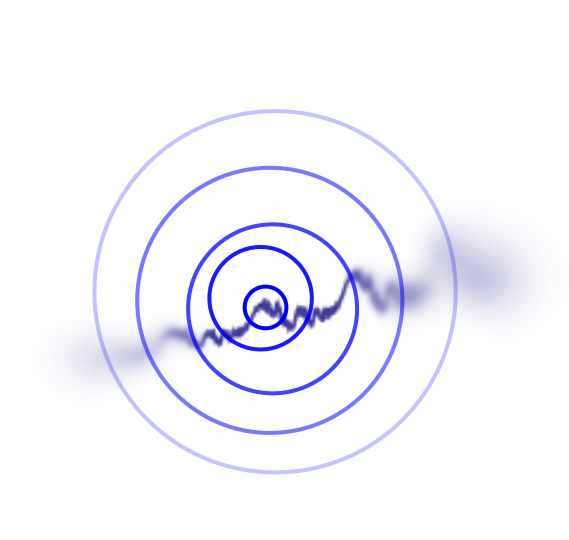
Let’s first expand the metaphor a little.

Image

Instead of a binary mode where we have the myopic tracking of the moment-to-moment curvature of the World flow and then another, more encompassing tracking (conscience), it would make more sense to think of a contextual gradient. Each sphere is like a specific attention span. Each greater sphere is able to grasp longer-horizon curvature. When these attention-span spheres are eccentric, our experience of becoming is locked into the lowest common denominator, so to speak. We experience the flux of phenomena from moment to moment, loosely trying to instill some tactical and strategic trajectory in the longer term.

Here we immediately meet the first obstacle to our default local realism. Drawn like that, it seems that we propose something like the block universe view, where spacetime already exists ‘out there’, and consciousness can expand to grasp more of it. There’s no need to imagine that, however. We can stay anchored in the here and now and consider the expanded attention span to be also in the here and now, except that it intuits more persisting tendencies of the World flow (initially, we can intuit such tendencies only regarding our own temporally extended intents).

When the spheres of attention span become more concentric (as in meditative concentration), it can be said that the shorter spacetime intervals feel musically and meaningfully embedded in the greater intervals. Such is also the case about conscience. A short-term spacetime interval may make local sense, yet it may fight a higher-order tendency. In that case, the attention-span spheres are eccentric; we either feel the clash of tendencies very dimly or not at all. Conversely, when the spheres are concentric, then even our moment-to-moment frames of existence feel musically embedded in a longer-term unfoldment that makes greater sense. The benefit of this contextual (instead of binary) view is that, effectively, we are always seeking the direction that makes sense (resonance), yet this direction is grasped in direct proportion to the concentricity of the attention span spheres. In this way, we do not need to see the local resonance tracking and conscience tracking as categorically distinct features.

Now what is the origin of this deeper conscience? The safest thing to say (from within our present secular stance) would be that this intuition is somehow the essence of consciously or unconsciously accumulated experience (wisdom). It’s like the present World state has accreted ‘tree rings’ of past experience, which may not be readily graspable at our moment-to-moment intellectual ticking, but nevertheless provide some background context (just like painful experiences in our childhood may feel today like reluctance to engage in a certain activity even though we may not be aware why).

All of this is fully compatible with materialism, except that we take a more inner stance, where we feel willfully pushing toward the next World state. It’s like we’re on a democratic trip and each human perspective exercises its ‘vote’; it contributes a push of the World state toward the next, and thus we collectively steer the body of humanity through various regions of World state-space that we call ‘the unfoldment of history’ (remember that even by thinking we push toward a World state that we yearn to manifest).

To better understand this process, we should be clearly aware that the greater attention-span spheres are not simply greater geometric volume of physical objects and more clock ticks. Every greater sphere grasps the existential flow at a certain level of integration, so to speak. For example, one such attention span can become known to human beings in the event of a near-death experience. Then, by being temporarily freed from the suction and distraction of bodily and sensory ticking rate, one may become concentric with an attention span that grasps our life journey more holistically. Now everything is seen on a more existential level. We realize how we may have been slumbering most of our life, living reactively to momentary sensations, chasing them and experiencing corresponding elastic bouncebacks, without much awareness of whether our life’s story is integrating into a more meaningful plot, let alone with the knowledge that we may have a proactive attitude toward this destiny.

Seen in this way, we can understand the historical process only when we seek these inner concentric or eccentric contextualities within which human destinies unfold. Of course, the reductionist mind of today will claim that even these contextualities are only intellectual levels of abstraction. In reality, there’s only flat energy flux ruled by the principle of least action. I think we have shown more than once that such beliefs remain abstract conjectures that cannot be lived by realistically, and in fact lead to a pathological psychological state where we effortfully try to prove our point, but when we are asked about it, we lift our hands and say, “I’m not doing anything! This is merely what the mechanical energy flux feels like!”

The question now is whether this human agency is at the border of agentic and non-agentic aspects of the World flow. Yes, certain aspects of the World flow that we are forced to track are steered by human intents according to their concentric or eccentric contextuality. To some extent, we can follow that even into the animal kingdom, but when we reach into the plant and especially the mineral kingdom, we are tempted to imagine that we are tracking a dark energetic landscape impinging on our sensory screen. Why is this tempting? Because it is convenient. We don’t need to get up from our intellectual armchair. We assume that the first-person frames of human experience constitute the complete palette that our knowing capacity needs to arrange in various storyboards and believe in the most plausible one. It feels immediately disturbing if it is suggested that we are yet to discover even more encompassing attention-span spheres with their corresponding causal roles (remember that attention tracking doesn’t need to be purely passive tracking of external phenomena, as it is clear when tracking the sounds of our inner voice).

It’s not even so much a question whether there are other agencies at these levels, but rather we can investigate for ourselves what existence at such an attention span could be like. If we awaken at such a level, then the answer about agencies will come by itself. In a similar way, if an animal could reason, it would never solve the question of whether there are such things as human agencies. It may track how houses appear, roads are built, books are written, and so on, but the question will remain open whether there are some meaningful perspectives behind these phenomenal ripples. Conversely, when the animal reaches its own egohood, the reality of other egos comes automatically. In the same way, we can only find a truly satisfying answer about the existence of an angelic perspective when we ourselves orchestrate and make concentric the attention-span sphere gradient up to that level. Then we begin to comprehend how, for example, human destinies only make fuller sense when we see that certain softening and guidance of the life-trajectories is contributed by such perspectives. Of course, we can keep pushing back. The animal reaching egohood can say, “But what if I’m the first ego in existence and I’m only projecting my egohood in the void?” Well, if we approach this from a purely logical perspective, we can ask, “Is it more plausible that all these phenomenal ripples (buildings, books, etc.) that would make perfect sense if seen as proceeding from the life of an ego, are actually only mechanical processes that just appear in this way?” It can only be said that such a question is practically impossible to ask in the higher spheres. While in the bodily sphere we can still hide behind the wall of sensory phenomena and fantasize whatever we like (including solipsism, Turing tests, etc.), in Imaginative cognition, the life of other perspectives intermingles with ours, so the only way to deny it is to zoom back inside the sensory sphere and build intellectual storyboards about what may lie on the opaque side.

So, unsurprisingly, I cannot give an answer that proves such spheres of attention are possible. I can only speak of how they make the picture fuller and can lead humanity in directions that make even greater sense – in ways that no sequence of purely bodily frames of existence can. In your case, I believe, it is important to realize what you are fighting with. The seeking of a purely mental and sensory-empirical justification of these questions is not at the core, just like Rodriel gave the example about the hard problem – “The problem is generated in part by the conceptual architecture we bring to it”. So things must be traced back to the origin. And this origin is a soul question. The embodied soul is torn between the tempting vista of a mechanical/energetic world-feel and one which is woven of meaningful intents through and through. Why is the first tempting? Because it alleviates us of responsibility. All our moral ideas and virtues, are only consensual protocols between agents that have risen from the dark abyss, in order to make their strange existence more bearable and predictable. On the other hand, if we are embedded in a Cosmos woven of intents traceable to coherent perspectives, then anywhere we ‘set our foot’, we ‘step on the head of a being’. This feels like an overwhelming responsibility at first. Yet, if we explore the contextual concentricity, we’ll also find that there’s a natural way to navigate such a World state-space. One which doesn’t consist of memorizing countless ethical rules, but of musical attention-span gradients that ‘make sense’. In fact, the core of this concentricity can be pointed at in a few words: “Thou shalt love the Lord thy God with all thy heart, and with all thy soul, and with all thy mind… and thy neighbour as thyself.”
Anthony66
Posts: 257
Joined: Wed Sep 01, 2021 12:43 pm

Re: Early/late Steiner

Post by Anthony66 »

AshvinP wrote: Sat Aug 22, 2026 4:53 pm
Anthony66 wrote: Sat Aug 22, 2026 1:53 pm OK, we dissolve the epistemic/ontic distinction. Empirical facts are constituted by the totality of agentic perspectives along the scales, with ours a minor contributor. It's all lenses, no reading is true in an absolute sense. But it's a hierarchical epistemology with some perspectives more veridical than others because they sit closer to the constituting scales. Higher-integration perspectives have privileged access to how the flow is really constituted, and SS with its "orthogonal awakening," "higher cognition," and "facing the incoming flow" seeks to occupy them. But climbing to a higher scale doesn't lift one out of accountability - it multiplies what you're accountable to. The higher scales are more constitutive - they carry more of the weight, they're the majority that outvotes the human anchoring. So a perspective that genuinely reaches them is surely answerable to a larger and more binding portion of the totality, not a smaller one. Ascending the hierarchy is ascending toward more constraint, because that's precisely where the constraint lives. The higher-cognitive scientist has not escaped the tribunal; they've been promoted into the chamber where the votes are heaviest and where deviation from the constituted structure shows up most sharply.

Coming back to earth, if the human-scale perspective supplies only a small fraction of the constitutive weight, then the constituted world is more binding on us, not less. Steiner's physical-world assertions, where they conflict, aren't being unfairly held to an alien standard; they're being outvoted by the totality that supposedly constitutes the fact. Again, the mistletoe shifts the survival curve or it doesn't; the biodynamic prep moves a measurable outcome or it doesn't.

Focusing back on my main concern here, how does a claim to have reached a higher scale get distinguished from a compelling projection that merely feels integrated? If reaching the integrated scale is real, it should produce the signature of the integrated scale: cross-observer invariance and stability under varied entry-conditions. If higher cognition genuinely occupies the more-constitutive scale, it should systematically out-anticipate the receded quantitative models it disparages. A higher perspective that reaches the majority-constituting scale but can never demonstrate superior grip on how that constitution flows down into the sensory plane is indistinguishable - by any available operation - from an ordinary human-scale intellectual construction.

It is safe to say that none of us would be so captivated by spiritual science and its inner method if the latter didn't feel like it was continually expanding intuitive orientation to the sensory spectrum of experience, expanding the curvature of memory and anticipation, at both the personal and collective scales. The key realization, as Cleric noted above, is that this expansion begins in our intuitive thinking process, which is felt as an inseparable aspect of the total World flow. We realize that, if this thinking process is always the means by which we intuit certain lawful relations within experience, and which subsequently lead to our empirical models, then the practical significance of those models can only be magnified when we explore the pushing-pulling forces modulating the thinking process itself. At the same time, we realize that the empirical modeling process of the experiential flow is what results when our natural (intuitive) knowing process is artificially constrained by these same pushing-pulling forces. Consider the following:

Lehr, Man or Matter: "We mentioned Heisenberg's speech as a symptom of a certain tendency, characteristic of the latest phase in science, to survey its own epistemological foundations critically. A few years previous to Heisenberg's speech, the need of such a survey found an eloquent advocate in the late Professor A. N. Whitehead, in his book Science and the Modern World, where, in view of the contradictory nature of modern physical theories, he insists that 'if science is not to degenerate into a medley of ad hoc hypotheses, it must become philosophical and enter upon a thorough criticism of its own foundations'.

Among the scientists who have felt this need, and who have taken pains to fulfil it, the late Professor A. Eddington obtains an eminent position. Among his relevant utterances we will quote here the following, because it contains a concrete statement concerning the field of external observation which forms the basis for the modern scientific world-picture. In his Philosophy of Physical Science we find him stating that 'ideally, all our knowledge of the universe could have been reached by visual sensation alone - in fact by the simplest form of visual sensation, colourless and non-stereoscopic'.3 In other words, in order to obtain scientific cognition of the physical world, man has felt constrained to surrender the use of all his senses except the sense of sight, and to limit even the act of seeing to the use of a single, colour-blind eye."


I provided some examples of how mistletoe therapy can shift the survival curve and biodynamic prep can move a measurable outcome. And as we mentioned, these expanded scientific inquiries are only in their infancy. We shouldn't expect perfect understanding or application, just as we shouldn't expect it in industrial agriculture or allopathic medicine. Steiner himself remarked on this in various places, for example:

Steiner: "Spiritual Science is certainly in a sense a Science, and as such it is, we may say, still in a “fragmentary” stage at the present day, only partly established; what it may eventually become can really only be present in the first beginnings at the present time... It might even be—in what science has this not been the case in the course of the development of mankind!—that much of what can and must be proclaimed today quite conscientiously from the sources of Spiritual Science might have to be corrected; that much may appear in another form in the future through the further progress of Spiritual Science. Then perhaps there may be a different content in one or another department of this Spiritual Science."

We should also strive to perceive how it is the peculiar nature of the single, color blind eye that it can always interpret the data in certain ways, or find counterdata, that will support its preferred intellectual destination (that was the main point of the numerical trick analogy). That is especially true because this eye willfully constrains itself to shorter and shorter measurement intervals when evaluating outcomes. For example, we can imagine, for the sake of argument, that there are some cases in which illness and even death lead to the most optimal trajectory for long-term Health (and other Ideals implicit in all human striving), but that this only becomes evident over the course of multiple incarnations (of course, this only makes sense if the soul is not identical with its physical basis). The point is not to blindly believe that is true, but to imagine how, IF it is true, the single colorblind method could possibly lead to its realization. It never would, because this method constrains itself so that the realization becomes impossible. Thus, the exclusively intellectual method establishes a kind of echo chamber in which its self-imposed limitations continually reinforce its preferred narrative of what counts as a 'valid measurable outcome' for testing the value of its knowledge.

So it all comes down to realizing that we can no longer afford to conceive "empirical dynamics" as only those that can be represented as momentary spatial transformations that help us navigate toward only the most myopic, short-lived goals within the whole spectrum of human striving at evolutionary timescales. That is like the human being who invests all their intellectual energy in reaching satisfying sensations on a daily basis, only to become dissatisfied again as soon as the sensory experience is exhausted and repeat the cycle. Likewise, the artificially constrained intellect synthesizes medications that treat the symptoms of already manifested disease, only for the various pathogens to begin resisting those medications and repeat the cycle. It then labels measurements that fit within this cycle as the only valid data to consider for what counts as 'medical knowledge'. Instead, we should realize that the pushing and pulling forces that constrain the quantitative modeling intellect are also inseparable parts of the total empirical dynamics that need to be investigated if there is any hope of expanded intuition and long-lived practical outcomes. Why not investigate these forces more directly, without the exclusive mediation of our stripped-down, quantized mental images?

Then we may begin to realize that our human-scale contribution to the seemingly stable empirical dynamics is not so minor after all. It helps, especially as we get older, to contemplate how our prior inputs have influenced our present physical state. After all, the empirical dynamics that govern certain aspects of our physical organism should not be so different from those at work in the natural world, which participates in the same forces and substances of that world. As we walk down the street, we could try to feel how various physical gestures, movements, and qualities can be intuitively traced to those prior inputs. For example, perhaps we feel a rumbling in our stomach that can be traced to our decision to eat or not eat certain foods a few hours ago. Then we may also feel soreness in our knees that can be traced to physical activities we engaged in excessively or recklessly a few years ago. The way we walk, our gait, our posture, etc., can be similarly traced to prior intents and corresponding inputs, perhaps dating back to early childhood. We could feel our whole physical state as a kind of tree with rings laid down at different times, in correlation with prior inputs. Of course, all of that would initially feel dim and nebulous. The point is to simply accustom ourselves to shifting our scientific perspective.

Is it so much different for the tree rings of collective life that come to expression in various physical dynamics that we try to model, for example, as weather phenomena and natural disasters? In the age of powerful technology, it has become even more obvious how humanity's collective inputs influence these natural phenomena, with progressively less delay. Yet those technologies are themselves obviously extensions of our intuitive life and our soul forces. Could we better anticipate these empirical outputs if we are more attuned to these empirical forces underlying our ideas, passions, desires, and so on, just as we could better anticipate economic fluctuations, violent conflicts, population dynamics, etc.? The important thing here is not to reach quantifiable models of how our inputs relate to the empirical outputs, as if we can calculate exactly how a certain constellation of inner gestures led to our sore knee, or to a massive thunderstorm, but to gradually accustom ourselves to a new way of feeling the IO relationships and temporally expanding our orientation to those relationships, without artificially constraining ourselves to the perspective of a single, colorblind eye that can only passively contemplate them in myopic measurement intervals.

If we feel satisfied with the latter as the absolute culmination of human cognitive striving, then we positively preclude ourselves from expanding temporal orientation within the total empirical dynamics. Only when we feel utterly dissatisfied with the constrained hamster wheel, and when we feel that we may be on the frontier of an entirely new scientific perspective (which, in a sense, restores the momentarily inverted intellect to its most natural knowing process), can we create the conditions for seeing those dynamics in stereoscopic, color-filled vision.
Your Eddington quote makes a strong point: physics idealizes toward a colorless, non-stereoscopic observational base.

Whereas you previously argued that the human-scale perspective supplies only a small fraction of the constitutive weight, now you are presenting the converse. Regardless, whether the human scale is minor or major, there is a tribunal in wait. If our contribution is minor, we're bound by the majority scale which SS claims higher cognition ascends into (reaching the more-constitutive scale is reaching more constraint, since that's where the fixity originates). If our contribution is major, then by increasing self-knowlege I should be able to anticipate the storm. This is empirically testable.
The important thing here is not to reach quantifiable models of how our inputs relate to the empirical outputs, as if we can calculate exactly how a certain constellation of inner gestures led to our sore knee, or to a massive thunderstorm, but to gradually accustom ourselves to a new way of feeling the IO relationships and temporally expanding our orientation to those relationships, without artificially constraining ourselves to the perspective of a single, colorblind eye that can only passively contemplate them in myopic measurement intervals.
The question is whether these IO relationships are real and traceable and therefore checkable at some scale or granularity. A long-horizon effect eventually registers somewhere in experience and the remedy is a longer study, no matter how hard this is. "Hard to measure" is an argument for better study design, not immunity to measurement. And prediction/verification doesn't require number or equation.
User avatar
AshvinP
Posts: 6716
Joined: Thu Jan 14, 2021 5:00 am
Location: USA

Re: Early/late Steiner

Post by AshvinP »

Anthony66 wrote: Sun Aug 30, 2026 1:10 pm Your Eddington quote makes a strong point: physics idealizes toward a colorless, non-stereoscopic observational base.

Whereas you previously argued that the human-scale perspective supplies only a small fraction of the constitutive weight, now you are presenting the converse. Regardless, whether the human scale is minor or major, there is a tribunal in wait. If our contribution is minor, we're bound by the majority scale which SS claims higher cognition ascends into (reaching the more-constitutive scale is reaching more constraint, since that's where the fixity originates). If our contribution is major, then by increasing self-knowlege I should be able to anticipate the storm. This is empirically testable.
The important thing here is not to reach quantifiable models of how our inputs relate to the empirical outputs, as if we can calculate exactly how a certain constellation of inner gestures led to our sore knee, or to a massive thunderstorm, but to gradually accustom ourselves to a new way of feeling the IO relationships and temporally expanding our orientation to those relationships, without artificially constraining ourselves to the perspective of a single, colorblind eye that can only passively contemplate them in myopic measurement intervals.
The question is whether these IO relationships are real and traceable and therefore checkable at some scale or granularity. A long-horizon effect eventually registers somewhere in experience and the remedy is a longer study, no matter how hard this is. "Hard to measure" is an argument for better study design, not immunity to measurement. And prediction/verification doesn't require number or equation.

That our human-scale inputs are constitutive of the empirical landscape is simply a given fact even for ordinary consciousness, except, as has been noted, when we get to the processes of the plant and mineral kingdoms. Here, it seems our inputs are only indirectly involved in shaping the outputs through technological extensions (for example, fossil fuel technologies that generate climate change). But how do these technological extensions come about in the first place? What are our technologies extensions of? This question leads us back to the core, which is not so much about verifying particular isolated details of historical or present life, but about what it means to 'verify' and 'seek the truth'. Although that has also been addressed in many different ways, I'm not sure it has been made explicit enough.

An immediate question comes to mind when the higher cognitive path is described: why are these higher modes of knowing so different than what we feel we are doing in our standard empirical inquiries (physical-objective consciousness), and what is the relationship between them? What does resonating with the inner life of other beings have to do with seeking the laws of nature that, when grasped, lead to all the modern advances in civilization? That's why the phenomenological foundations are so important, since they help us more clearly intuit how our ordinary truth-seeking consciousness (picture-in-picture intellectual flow) fits within the attention-span spheres. To state it very explicitly: whenever we seek to carefully observe, understand, predict, anticipate, verify, etc., our sensory experiences and corresponding mental images, we are (usually instinctively) seeking to make the attention-span spheres concentric.

What could the process of seeking 'laws of nature' be other than feeling how the shorter spacetime intervals of our sensory perceptions and mental images are musically and meaningfully embedded in greater intervals? When a botanist observes the stages of a plant’s growth and decay, for example, recording their memory images and formulating the characteristic dynamics of plant development, that is only possible because the ‘Plant-being’ (or Urpflanze) pressures their concentrated state. The intuitive experience of the Plant-being's attention span precipitates as sensory impressions which, after immediately fading, can be lifted as corresponding memory images. The latter are then usually quantified and elaborated into a model. Because the botanist experiences these perceptions in a temporally decohered manner (the squiggly line in Cleric's illustration), however, they find it very difficult to realize their own intuitive participation in the dynamics observed. This temporal decoherence can also be understood as an out-of-phase relationship between intuitive intents and empirically observable outputs (greater delay).

So, as the Lehr quote hinted, all of these questions you are asking ultimately boil down to how we understand the epistemological foundations of science (or any other domain of thinking inquiry), not as some theoretical philosophy that we hold as yet another series of mental images, but as Rodriel noted, a participatory epistemology in which our thinking process learns to intuitively feel the constraints in which all its inquiries unfold. As Cleric said, it is a soul question whether we want to experience that participation or continue imagining we are a detached observer modeling dynamics that exist on the opaque side of our intuitive experience. That is even more apparent when we move from claims pertaining to natural scientific dynamics to those pertaining to 'racial evolution'. Then it becomes even more important to trace our mental images back to their origins. Just as most natural scientists have a vested interest in their theoretical assumptions and models, many modern people feel vested in their opinions on various cultural groupings, especially when those opinions take shape through emotional attachments. Steiner once observed a comical example:

"I had to explain that animals have group souls, and that when animals die, they merge into the group souls—that they do not undergo individual reincarnation. A woman who had a dog she loved very much replied: That might be the case for all other animals, but it didn’t apply to this one—her dog—because he had already developed such a distinct individual soul that he would experience personal reincarnation. It was very difficult to get through to the lady. But afterward, when she had left and a few of us were still together, another lady said: She couldn’t understand how such an intelligent woman couldn’t see that her dog didn’t have an individual soul; she had understood that right away! But her parrot—he had an individual soul! That was a completely different matter! — This is a very instructive example of how people judge when topics are raised that are directly related to their personality."

Likewise, when the embodied personality identifies strongly as belonging to a certain group, or, as increasingly common in our time, being a self-appointed ‘defender’ of various groups, the objective facts of spiritual scientific research are more easily brushed aside or distorted whenever it feels convenient. Then the 'altimeter' becomes our personal feelings. Very often, these feelings mask an underlying fear or hesitation to seriously explore the relevant inner dynamics, to expand consciousness into the greater attention-span intervals that comprise the collective intelligence of 'folks'. These coherent perspectives steer the flow at their scales, and this projects as the process of 'racial evolution' (which, due to temporal decoherence, is actually a lingering echo in our present time of past steering). In any case, we can only properly orient toward all these questions when we intuitively observe the scale-invariant dynamics of 'making sense' or 'seeking truth'. We need to get a better feel for what we are always doing in our intellectual modeling activity, which alone makes it possible to remember and anticipate the lawful curvatures of the empirical flow, to devise our technologies, and to modulate the empirical landscape.

PS - what you write in bold is a great motto for the spiritual scientific method :)
"They only can acquire the sacred power of self-intuition, who within themselves can interpret and understand the symbol... those only, who feel in their own spirits the same instinct, which impels the chrysalis of the horned fly to leave room in the involucrum for antennae yet to come."
Post Reply